Two cities, no trains, years of delay: how failed politics destroys growth
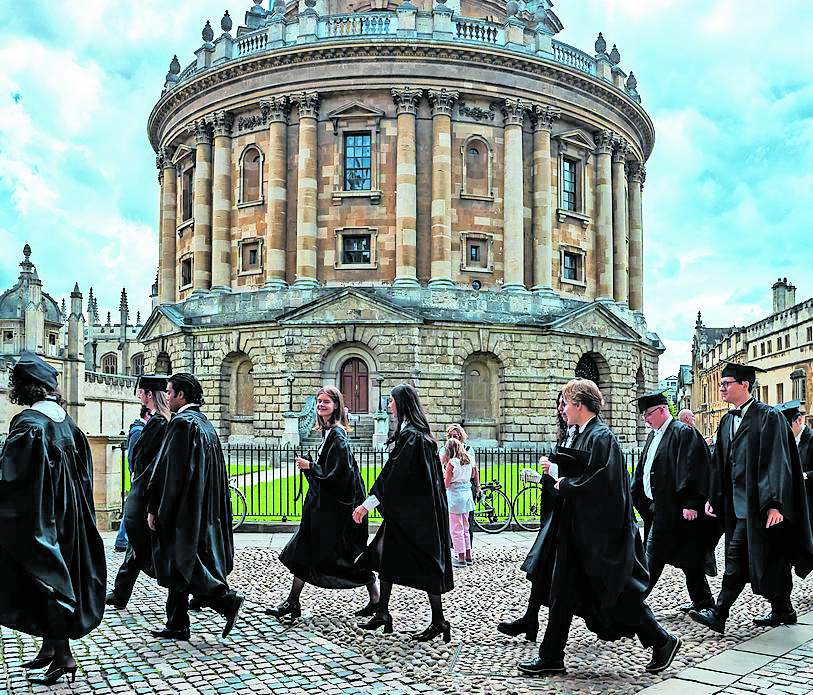
‘‘ I’m writing this column sitting here in my office in Oxford. In my inbox are several invitations to attend events and give talks in Cambridge, including a symposium on economic growth. I have turned down almost all of them, and am currently havering over whether to accept that last invitation.
Ironic. That I’m dithering over the invitation to the growth symposium is one of the reasons that we have such a problem with economic growth in this country. Obviously, I’m not claiming any personal impact on our economic wellbeing. But the reason for my hesitation is the impossibility of travel between Oxford and Cambridge in anything approaching a sensible time. The utterly pathetic transport links between these two cities — and many, many others — is a real contribution to our national stagnation.
Oxford and Cambridge lie a mere 66 miles apart. They may as well be in different countries. The only way to get between them on public transport is a three hours-plus journey by train and Tube via central London, involving changes at Paddington and King’s Cross. Driving can take a similar time. For comparison, you can travel nearly three times that distance by train, from London to York or Manchester, in about two hours.
Oxford and Cambridge contain, on any measure, two of the world’s greatest universities. They are two of the most productive and innovative cities in the country.
A third, Milton Keynes, sits between the two. They all lie within 70 miles of one another, yet operate as entirely separate places. They are desperately constrained not only by poor transport links, but by lack of housing, lab space and other infrastructure.
A new paper, “The lost Oxford- Cambridge arc”, published last week, set out in gory detail the policy failings over the past decade that have cost the country billions by not taking advantage of these unique opportunities. Its authors, Sir John Kingman and Baroness Vadera, were colleagues of mine in the Treasury two decades ago, though have for a long time now been playing leading roles in British business.
Back in 2017 the National Infrastructure Commission set out plans to create up to a million new homes, a railway and a road linking Oxford, Milton Keynes and Cambridge, as well as new towns along the route. The economic case was overwhelming, promising huge gains, and the plan appeared to be endorsed by the government of the day. But bit by bit it has been chipped away.
The rail plan has gone the way of all rail plans.
First promised in 2012, with part supposedly open by 2017, the earliest we can expect full opening is the late 2030s.
Astonishingly the first part of the line, between Oxford and Bletchley, was completed two years ago but as yet no passenger trains are running on it, in part because of a dispute over who should operate the train doors. You couldn’t make this stuff up.
Plans for a new road have simply been abandoned while plans for new towns and a million new homes have gone nowhere.
To rub salt into the wound, note that the Department for Transport is, this year, spending more on the HS2 white elephant than on all other rail projects combined, and twice as much as on the entire national highways programme.
Oxford, in particular, is being strangled by lack of new housing, and resultant eyewatering rents and house prices. The lack of housebuilding alone along this corridor is costing the economy tens of billions. And as Kingman and Vadera show, the huge uplift in land value that would arise as a result of development could be used to pay for much, if not all, of the required capital cost of development.
An acre of farmland in south Cambridgeshire is worth about £9,000. The same acre with planning permission for housing is worth £1.9m. We are leaving money lying in the road.
We have an opportunity to create a hugely successful, world-class, hightech corridor driving growth, productivity and jobs across the country. It is no exaggeration to say we could build a rival to Silicon Valley. Instead, we have seen yet another example of our failed polity.
Grand plans announced, but nobody responsible and nobody taking responsibility. New ministers every year or so, each with a different vision. Decisions delayed and then abandoned. Potential unfulfilled.
Kingman and Vadera are not the only business leaders losing patience with government failures that have helped consign us to two decades of economic stagnation; not the only ones with a genuine desire to help the country back on the right track. I have been working with the chairs of several FTSE 100 companies as part of the 2030 Prosperity Alliance. We have come to much the same conclusions about the problems. We call them “giants” that need to be tackled if we are ever to get our incomes growing again.
The Oxford-Cambridge fiasco illustrates all too well at least three of those giants. First, neglect — the long-term failure to invest enough in general, and in housing and infrastructure in particular.
Second, gridlock — the stifling effect of regulation and planning constraints that hobble innovation and make building in this country more uncertain, time-consuming and expensive than almost anywhere else in the world.
Third, myopia — the failure of governments to plan effectively for the long run and pursue consistent policy, as they continually prioritise immediate political advantage over the long-term prosperity of the country.
That in the end is why the most striking thing to come out of the recent budget was the Office for Budget Responsibility’s forecast that household incomes will rise by a pitiful 1 per cent over the entirety of this decade. That’s also why I may never make it to that symposium in Cambridge.
Paul Johnson is provost of The Queen’s College, Oxford, and a senior adviser at Frontier Economics


Comments
Post a Comment