Real lessons of Trump’s impetuous action
Ten minutes after the capture of Nicolás Maduro was announced on social media, the White House correspondent of the New York Times wanted words from the administration for his paper’s rolling news coverage. Fortunately, he knew just who to call.
He dialled the president of the United States. Donald Trump answered after only three rings and gave him an interview on the spot. It was 4.30 in the morning.
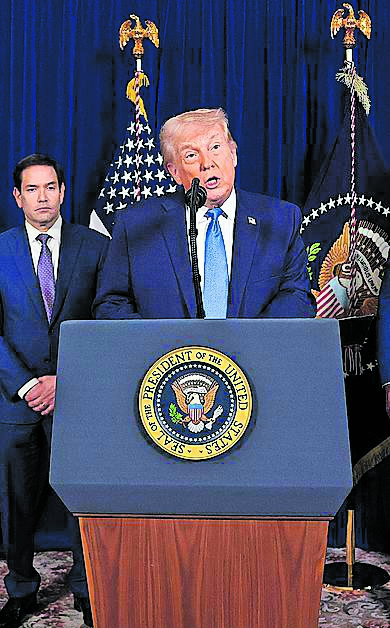
A few hours later the president, looking slightly worse for wear, held a press conference and told a startled collection of correspondents gathered at his Palm Beach social club that he now intended to “run Venezuela”. There were no answers on how he intended to do this or even how he intended to be in a position to do it. He did not know how long he was going to do it for, or even how he would know it was time to stop doing it.
It wasn’t obvious that he or anyone else had given thought to any of those problems. Neither at 4.30 in the morning nor later that day did he provide any details. Nor was there any discussion of the legal position, internationally or domestically. By the way, given that Maduro is being charged with a number of offences, and tried by independent courts, it would be interesting to know what happens if he isn’t found guilty. But there was silence on that too.
Answers to some or maybe all of these questions will doubtless emerge. But as a way of conducting government it was, to say the least, unconventional. And it’s hard not to foresee trouble ahead as a result.
So there is all that. But there is also something else. Maduro has been a catastrophe for the people of Venezuela. He has been a nightmare for his country’s neighbours. He cheated in the election, losing despite all of his repression. And he isn’t legitimate in any way. Yet there he was. For years and years, there he still was. And now he no longer is, because Trump has removed him.
The US president didn’t spend years considering all the reasons not to act, he didn’t consult all the stakeholders who might have told him it was too risky, he didn’t get bogged down in legal arguments. He just went ahead. And then, when it was done, he put it out on social media and picked up the phone and answered questions about it at 4.30am. It is a perfect example of the big tension in modern politics — progress versus process.
People want progress on immigration. What they get is process
In his 2025 book Breakneck, Dan Wang contrasts China and the United States. He calls the former an engineering state and the latter a lawyerly society. With China “building big at breakneck speed” and America’s system “blocking everything it can, good and bad”.
Wang shows how the leadership of China is dominated by engineers and has been since the early 1980s. And he provides the extraordinary fact that between 1976 and 2020 every single nominee of the Democratic Party for president and vicepresident of the US had been to law school. And that was still true of their presidential nominee in 2024.
Much of Breakneck is an account of vast tunnels and bridges and roads being constructed by the engineering state, of huge buildings being erected in weeks, of power stations and factories and parks all appearing within months of being conceived.
Meanwhile the lawyerly society plods along, holding committee hearings and judicial reviews.
His target in the book is America, but in an end-of-year letter, reflecting on how his ideas had been received, Wang had Britain in his sights.
“Every problem in the lawyerly society is worse in the UK. I thought that California’s high-speed rail project was an embarrassment; then I learnt about the Leeds tram network. First legislated in 1993, mass transit might not come to West Yorkshire until the late 2030s.”
Donald Trump acts as he does partly because he can’t help himself.
He is impulsive and he doesn’t care to wade through a lot of papers or pay attention through lengthy briefings. He thinks he’s a better press officer for himself than anyone else and he likes answering his phone. So subverting the usual way of things is partly personal preference.
But it is also partly political calculation. Voters want better outcomes. They want things to happen. They are either uninterested in process or actively hostile to it.
They just want someone to get on with it. Pollsters in Britain find that while voters may not like Trump, may even be actively hostile to him, he is a model of what real change looks like. He acts.
Wang’s British example was a tramway but he might just as easily have mentioned immigration. People want progress on controlling immigration and what they get is process. They want someone who is here illegally to be removed expeditiously. The don’t want foreign criminals to stay here for reasons that elude understanding. Politicians are articulate at explaining why various sorts of law mean they can’t do things people think are mere common sense.
It was telling that when the Tories were accused of granting citizenship to the Egyptian dissident Alaa Abd el-Fattah, they hadn’t really done so.
He had gained it automatically due to laws they weren’t in control of. It was also telling, and right, that this defence of their actions did no good at all to anyone who mounted it.
People don’t want a process answer.
Yet not all the arguments between progress and process favour the former over the latter, by any means.
It’s a tension not a choice. Wang shows that China erects buildings that fall down too easily, that its bridges often go nowhere, that it amasses huge debts making economically questionable investments. Quite apart from the impact on individual rights.
In Britain, impatience with public procurement was well founded and obtaining PPE became an emergency during the Covid lockdown. But it can’t be said that entirely overturning process had altogether satisfactory outcomes.
The same will prove true with Trump’s Venezuelan adventure.
Acting without allies, or a careful plan for the aftermath, is incredibly risky and abandoning any sort of consideration of international law will prove short sighted. And one day the president will bring disaster upon himself and everyone else by answering the phone to whoever happens to call him at 4.30 in the morning.
Advanced liberal democracies risk become less advanced, less liberal and less democratic because they can’t get things done. They make a fetish of process and can’t progress. But being wholly cavalier about process and institutions won’t work either.
We can’t do without progress and we can’t do without process. The world is in desperate need of statesmen able to find a middle path.


Comments
Post a Comment