Students fed up with bribes and beatings vow to oust PM
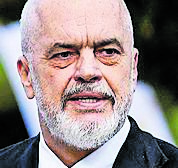
She is only 19 but Glevia has already dodged rubber bullets and been hit by tear gas and pepper spray so there is little chance that the £4,600 fines introduced by Edi Rama, the Albanian prime minister, will stop this young protester. “These fines change nothing — it’s just a scare tactic. I’ll be on the street on Saturday,” she said.
She was chatting with her fellow architecture students outside parliament during a lull after two weeks of clashes between protesters and police that left Albania’s capital, Tirana, looking like a war zone.
Shops, government buildings and bus stops have been wrecked, traffic lights decapitated to remove security cameras — causing traffic gridlock — and cobbled streets ripped up to provide stones to throw at police.
Glevia and her friends vowed to take part in the next expected battle at the weekend to protest against what they call crippling corruption, despite Rama approving the fines on Wednesday for those who merely show up at a clash.
Alisa, 21, looked at the water cannon vehicle pointing straight at her outside parliament and quipped: “They’ve been changing the colour of the water from blue to red to orange, and I want to see what colour they pick on Saturday.”
Jesmina Sengla, 24, a student, added: “These fines just made people angrier.”
As protests have spread through Spain, France and Italy this autumn, Rama has claimed his fines are in line with those issued by President Macron in France and Giorgia Meloni, the prime minister of Italy, for violence and vandalism.
He has blamed Russian and Iranian misinformation for stoking violence in his country. Albania is the target of a “hybrid” war, he argues, echoing language used by the Italian government.
“This crowd of urban thugs and online harassers” has whipped up a “frenzy of violence” to take Tirana hostage, he said.
Speaking to The Times, protesters from the leaderless protest movement argued that Rama was the one to blame.
As he casts himself as a victim like Macron and Meloni, they alleged he was the real culprit, having carried out creeping, corrupt Serbian-style state capture since taking office in 2013.
Roden Hoxha, a professor of law at the University of New York Tirana, recalled how protests had begun peacefully in May after Rama changed the law to allow a stretch of idyllic protected coastline to be turned into luxury villas by a consortium linked to President Trump’s son-in-law, Jared Kushner.
“Kushner was a catalyst for protest about the non-accountability of this government,” Hoxha said. “Protesters screamed nightly for months and Rama ignored them, which is why things turned violent this month. And suddenly, as the cobblestones start flying, he wants dialogue.”
When, last Sunday, the prime minister placed chairs outside his office as an invitation to talk, protesters set fire to them and demanded his resignation.
As cafés filled up and shoppers crunched over broken glass this week during the break from clashes, demonstrators described how corruption was affecting their daily lives.
“Why am I fighting? I took my granny to hospital and the doctor wanted €50 to write a prescription,” said Bledi, 19, who wore his mask outside parliament this week despite Rama’s new rules threatening six months in jail for covering one’s face in violent protests.
Ani Marku, 33, said: “I am trying to make a living as an architect but every big building contract is handed to a small group of oligarchs who control Rama like a puppet.”
In a survey, 80 per cent of university students said they had experienced corruption at their faculties, including paying bribes of about €100 to pass exams.
Rama oversaw the creation of an independent anti-corruption task force of prosecutors known as Spak, only to watch as it investigated more than 80 politicians — many of them his own allies — for corruption and ties to organised crime. Targets have included ministers, MPs, mayors, judges and two former deputy prime ministers, one of whom fled to Switzerland.
In a bizarre case, prosecutors placed Vlora Hyseni, the domestic intelligence chief, under house arrest in September, alleging she had helped a fugitive, Ergys Agasi, avoid capture. He was detained in August, accused of teaming up with police officers and gangsters to extort contracts from the digital records agency by kidnapping staff.
“Rama has said crimes by people around him should be judged individually.
He has talked of people ‘eating fruit behind my back’,” Lutfi Dervishi, an Albanian political analyst, said. “The problem is that with so many people eating fruit, you have to wonder if he is taking care of the garden.”
An Albanian law enforcement source told The Times that measures were being discussed in parliament to weaken Spak, although it remains untouchable due to EU and US backing.
Albanians also back Spak, but protesters say they have little faith in the police at protests. Elvis, 25, a software engineer, said he was detained after checking out a demonstration for 20 minutes on his way home from work.
“Ten of them blinded me with pepper spray then beat me with iron rods,” he said. “I ended up in jail alongside a Red Cross volunteer who had lost his hearing in one ear after being beaten. This collective punishment is a throwback to Albania’s communist past.”


Comments
Post a Comment