Putin’s strongman ‘readies his thugs’ in high-stakes vote
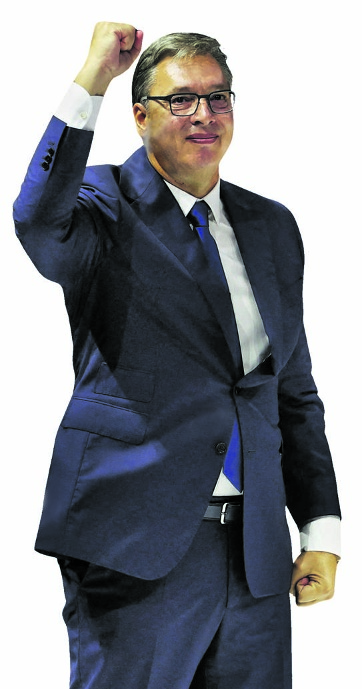
As night fell at a busy roundabout on the edge of Belgrade, Valentina Stanic, 30, was filled with dread. For all the dancing, whistles and lit sparklers as activists challenged the rule of the Serbian strongman Aleksandar Vucic, trouble seemed likely as next Sunday’s general election neared.
Polls suggest it will be tight and Vucic has readied his supporters, placing 1,500 reports in pro-government media warning that there will be violence on the day. This week, his opponents had a glimpse of the danger when a security guard revealed that he had run gangs of thugs who beat up protesters, as well as “trampling the police so the students would be blamed”.
Stanic, an advertising manager, said: “We know we are the majority, but if we win the government is going to deny it, they won’t go easily. I’m really scared there will be violence, but I will be down on the streets protesting — I have no choice, I love my country.”
Both Vucic’s supporters and his opponents expect clashes when polling ends on October 25 as he seeks to cling to power with the aid of a corrupt political machine, tight control of the media and backing from President Putin of Russia, who does not want to lose another eastern European ally after Viktor Orban fell in Hungary.
The vote in Serbia will be held nearly two years after a poorly built railway station canopy collapsed in Novi Sad, near Belgrade, killing 16 people. The incident prompted peaceful, student-led mass protests against corrupt government contracting. Demonstrators have been beaten up by hired thugs and last year were allegedly blasted with a sound cannon.
The protests are the biggest challenge to Vucic, who has been in power since 2014 as prime minister and then as president. Due to reach his constitutional term limit as president in May, he called snap elections last month to seek a return to the role of prime minister — copying Putin’s job swap routine.
Serbia’s students have put up a list of candidates — most of them their professors — with no named leader and a simple focus on reviving the rule of law. Vucic has warned potential protesters that Serbia could follow Georgia, where the ruling party was accused of massive vote rigging to win re-election in 2024 before the police were sent to beat up protesters. “It went on for seven days, and they cleared [protesters] off the streets,” he said. “So they didn’t achieve their goals in Georgia either. And they won’t achieve them here.”
The security guard turned whistleblower Momcilo Marjanovic told Balkan Insight this week that at the height of the protests in March last year, when 300,000 demonstrators descended on Belgrade, 100 armed men were hidden in a tent city by parliament ready to shoot, before the students pulled back.
Over two years, he said, he had paid thugs up to €400,000 to become a private army for Vucic’s party. The cash, he said, was provided by a manager at a municipal heating company.
Oliver Toskovic, a candidate on the students’ list, said as he manned an electoral stand in central Belgrade this week: “I can’t believe they are saying us protesters are violent when they have the police, the army and paramilitary thugs.” Toskovic, 49, a philosophy professor at the University of Belgrade, added: “We really hope the EU will be watching the election closely.”
Across the street, at a rival stand set up by Vucic’s supporters, the council worker Branislav Zec trotted out the government accusation that the students were being funded by foreign intelligence services. “Where are they getting their money from? Germany? The UK?”
Rasa Nedeljkov, the head of CRTA, a non-governmental organisation monitoring the Serbian election, had a grim prediction for polling night. “If the students are winning, Vucic will allege voting irregularities and call for re-votes, or if it’s close he could claim victory. Both scenarios would spark protests and he would send in the police and infiltrators to stoke violence so he can claim Serbia is under attack by foreign-funded forces,” he said. “I am only reading their own script: Vucic and his party officials have spent months claiming foreign intelligence services are plotting a ‘colour revolution’. I fear October 25 will just deepen the crisis.”
CRTA has been raided by police and bugged, but Nedeljkov said it was determined to send hundreds of monitors to polling stations.
“Our observers have been attacked while the police did nothing, and we believe that will be the method this time. We are witnesses at the ballot box, and Vucic does not want witnesses.”
Borko Stefanovic, an opposition MP, said: “You see men at polling stations in ski masks checking voters who need to show a photo of their ballot — it’s a well-oiled machine.”
Vucic has previously denied vote tampering at elections.
His allies’ purchases of Serbian media to stifle such reports allegedly continued this year when a Portuguese company with links to Orban took over two of Serbia’s last big critical TV stations, N1 and Nova S.
Staff at Nova’s website were this week given 48 hours to leave if they objected to a new manager who, they said, worked at a pro-Vucic tabloid. The veteran British war correspondent Brent Sadler, hired by the Portuguese owner to oversee the channels, told The Times: “Not one single story has been suppressed since I took over.”
The investigative news site Krik, which has chiselled away at Vucic’s alleged ties to organised crime, is being bogged down by an onslaught of Slapp lawsuits from Vucic’s inner circle, its editor, Stevan Dojcinovic, said. “I suspect the government has taken over the media court, promising judges promotions, which is why we’re seeing some bizarre verdicts,” he said.
A foreign agent bill has been pushed by Aleksandar Vulin, Vucic’s former spy chief and deputy prime minister, who has been sanctioned by the US for alleged ties to organised crime and drugs and arms trafficking. Vulin is a point man for Russian-Serbian intelligence sharing, and last year met the Kremlin official Sergei Shoigu in Moscow to discuss how to stifle the student protests.
Putin is keen to keep Vucic in power, according to Srecko Dukic, who was a Serbian ambassador to Belarus before Vucic rose to power. “Putin is known for not wanting to change his partners, especially if they are weak, like Vucic or Belarus’s Lukashenko,” he said.
Ilija Srdanovic, 56, a cardiologist and professor at the University of Novi Sad, who is the leading students’ candidate, revealed that he was beaten up two weeks ago and had had his Instagram account shut. However, he appealed to supporters to avoid violence, even if Vucic tried to fix the vote. “We do not support any violent reaction,” he said.
The students’ backers obeyed that call last March, staving off a possible bloodbath. But at a night rally in the Konjarnik neighbourhood of Belgrade this week, Jenna, a 23-year-old student, said she would not stay at home on election night. “Vucic will steal every vote he can,” she said. “On Sunday, I will either celebrate or fight.”


Comments
Post a Comment