Larry Ellison Risk Exposed by Paramount and Oracle Debt Binges
Translate
5:20
As Paramount Skydance Corp. and Oracle Corp. vault into the ranks of corporate America’s biggest borrowers, their links to the same man — billionaire Larry Ellison — are starting to stir angst on Wall Street.
The assumption among many investors has been that Ellison would step in to support Paramount if it got in financial trouble after taking on $52 billion of additional debt this week to help pay for its acquisition of Warner Bros. Discovery Inc. But with much of the Ellison family’s wealth tied to Oracle shares as the company undertakes its own capital intensive AI buildout, the worry is the value of that safety net could come under pressure just when Paramount needs it most.
Those concerns are already being reflected in the market, money managers say. The cost to insure the debt of both companies against default has converged and is increasingly moving in lock-step, a sign investors are beginning to treat the two credits as intertwined. It’s another factor lenders need to consider when assessing the mounting debt and execution risk of the firms, according to Campe Goodman, a portfolio manager at Wellington Management Co.
“You have to consider your total Larry Ellison risk,” Goodman said, adding that investors should regard Oracle and Paramount as related bets rather than completely separate credits. “You probably want to consider your exposure to both.”
Representatives for Paramount and Oracle didn’t respond to requests for comment. Attempts to reach Ellison through his foundation also went unanswered.
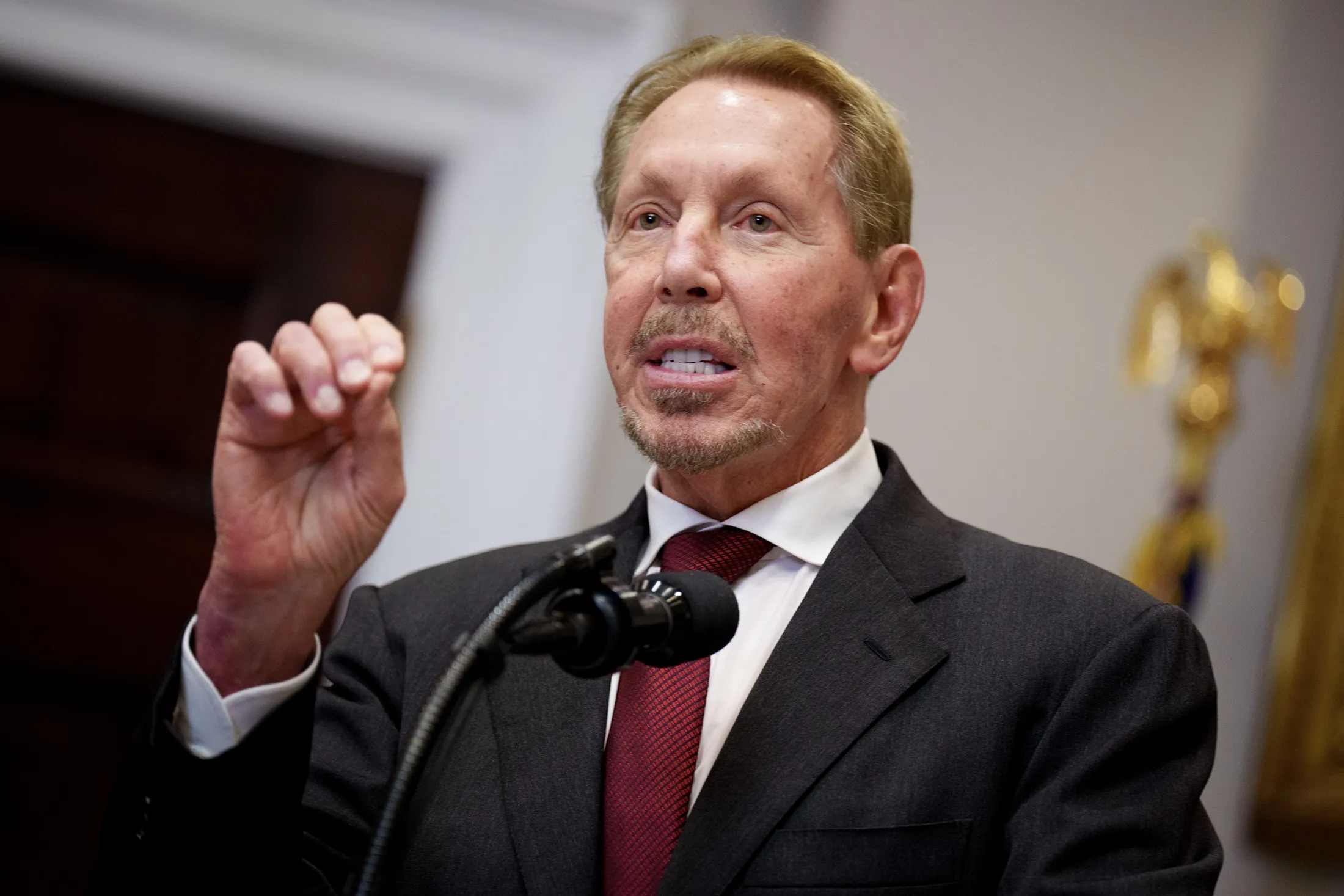
Ellison, 82, is backstopping Paramount’s takeover of Warner Bros., spearheaded by his son David, via a family trust that guaranteed a significant portion of the roughly $47 billion of equity financing for the deal.
Yet his support also extends beyond the acquisition itself. As Paramount worked to reassure ratings firms about the debt burden the combined company would carry, the Ellison family pledged to take all necessary steps to help bring leverage down in the coming years — a commitment that credit graders and investors viewed as a tacit promise to inject additional capital if needed.
That makes Ellison’s ability to follow through on the pledge a key consideration for debtholders.
Just a year ago Oracle’s shares soared to a record amid surging AI optimism, briefly making him the world’s richest person.
Since then, his fortune has plummeted by almost $200 billion — more than any other person on the globe, according to the Bloomberg Billionaires Index.
To be clear, he’s still worth roughly $192 billion, enough to place him among the 10 richest people. But the sharp reversal shows how drastically his fortune can gyrate based on Oracle’s stock price.
Last month, Ellison canceled a plan to sell billions of dollars worth of stock in the company, in which he still owns a roughly 40% stake. He also disclosed he had increased the number of shares pledged as collateral for his personal loans.
“The businesses couldn’t be more different, but the market is starting to connect them through a common sponsor,” said Steven Schweitzer, a portfolio manager at Advent Capital Management. “Part of the Paramount credit story is tied to confidence in the Oracle story, because Larry Ellison’s financial strength sits behind both.”
Paramount’s financing package, which wrapped up Wednesday, included $30 billion of US dollar investment-grade bonds, $12.4 billion-equivalent of junk bonds and $9.46 billion of loans. In conversations ahead of the sale, investors considering whether to buy in were actively discussing how much weight to put on the Ellison family’s pledge, according to market participants.
“The issue is if Paramount’s not doing well and Oracle stock drops a lot, then you still have the same asset base, and that’s where there is potential linkage,” said Jawad Hussain, an analyst at S&P Global Ratings. That could leave the market asking, “‘could it impact the Ellisons’ ability to support the Paramount asset,’ which needs to de-lever.”
Oracle, for its part, has nearly doubled its long-term debt to more than $160 billion over the past two years, as the company refashions itself as a provider of computing power for artificial intelligence work. It now ranks as the fifth-largest borrower in the US corporate bond market, according to Bloomberg index data.
S&P in July cut Oracle to BBB-, the lowest investment-grade rating, as heavy spending pushed free cash flow deeply into negative territory. Last month it lowered Paramount’s issuer credit rating to BB, two notches into junk, on expectations for increased leverage following the Warner Bros. acquisition.
Oracle’s debt-fueled spending surge has spooked equity investors, too, overshadowing robust growth in its cloud-computing division and driving a more than 50% decline in its share price over the past year.
For More Oracle Coverage:


Comments
Post a Comment