- Get link
- X
- Other Apps
China Plows Ahead In Uyghur Region
Controversial Xinjiang is key to plan to expand exports, energy production
BY BRIAN SPEGELE
KASHGAR, China—Four years ago, the United Nations human-rights agency said China’s abuses in its far western Xinjiang region were so severe that they potentially amounted to “crimes against humanity.”
The U.S. limited imports from the region and blacklisted dozens of Chinese companies over growing evidence that ethnic Uyghurs were being arbitrarily detained and used in forced labor.
Global firms such as BASF and Volkswagen sold their stakes in factories in Xinjiang, while Nike and H&M pledged that they weren’t sourcing products from the region.
Yet a visit by The Wall Street Journal showed leader Xi Jinping is plowing ahead in transforming Xinjiang, despite international condemnation.
In Kashgar, a historic Silk Road trading post, shopping malls were jammed with Chi-
nese shoppers and Western brands, including Under Armour and Dairy Queen. Range Rovers cruised the city’s streets. Exports of local products, from walnuts to heavy-duty trucks, have surged, thanks in part to rising demand in Russia and Central Asia.
State-backed companies are flooding the region with cash, building solar farms and data centers. Officials are racing to invest billions of dollars to turn Xinjiang into a huge trade and logistics hub, including a new rail line that aims to shave a week off shipping goods by train from China to Europe. Xinjiang’s foreign trade jumped nearly 20% last year.
Growing tourism, meanwhile, pumped $50 billion into the local economy last year, according to official data, as curious Han Chinese and foreigners alike came to experience China’s Western frontier.
A giant banner at the newly expanded airport in Urumqi, the regional capital, gave thanks to Xi for his devotion to Xinjiang.
In Kashgar, middle-aged Chinese men in cowboy hats descend from tour buses to chow down on grilled lamb skewers and pilaf. As they wander the streets of the old town, they are less than 10 miles from several suspected detention centers operating during the height of China’s crackdown.
Severe human-rights abuses continue, according to U.S. officials, advocacy groups and ethnic Uyghurs, including forced labor, widespread restrictions on religion and cultural expression, and a crackdown on what Beijing broadly defines as terrorist and separatist activity. People in Xinjiang have been targeted for offenses as simple as growing a long beard or maintaining contacts abroad.
China wants to present a unified nation centered on the language and customs of China’s Han majority. In the process, it aims to further enhance Xi’s power by narrowing the space within Chinese society to speak and behave differently.
For China’s actions in Xinjiang, it has been a “decade of impunity,” Human Rights Watch said in August.
China’s Foreign Ministry, in response to questions, rejected allegations of forced labor and other abuses. It said the publicsecurity satisfaction rate in Xinjiang was 99.42% as of 2024. The statement added that Human Rights Watch was prejudiced against China and fabricated falsehoods.
“Certain countries repeatedly hype up Xinjiang-related lies and rumors to smear the Chinese government’s governance policies in Xinjiang,” it said. “Xinjiang today enjoys social stability, prosperity, ethnic unity, religious harmony, and its people live and work in peace.”
Yet much of the international outcry has faded, and foreign governments have grown quieter on the issue as they seek stable relations with China.
Instead, Xinjiang has become a showcase for the power Xi wields to jam through changes he deems in the national interest. It also provides one of the starkest examples of a worldview he has laid out repeatedly in speeches: For any problem, even delicate ones of ethnicity and culture, absolute Communist Party control is the only answer. Going forward, success in Xinjiang could further embolden Xi as he demands stricter party loyalty across the nation.
Forced submission
Xi’s ability to transform Xinjiang has been driven by fear, both among residents as well as local officials who could face prison if they dissent.
The government argues Xinjiang has benefited from the party’s leadership. “Xinjiang has entered a historical period, with its best development, greatest transformation and most tangible benefits for people of all ethnic groups,” said Chen Xiaojiang, the region’s top leader, who spoke at a conference on local cross-border cooperation attended by the Journal.
While ethnic Uyghurs, most of them Muslim, make up the majority of the population in Kashgar and some other parts of Xinjiang, their language is being replaced by Chinese.
Government billboards urge locals to speak the “national common language” of Mandarin, reflecting a new law that mandates the use of Chinese as the primary language in schools. Some Uyghur children, playing together after school, now chat together in Mandarin instead of the Uyghur language— and an official initiative encourages parents to learn Chinese alongside their kids.
The new law “promoting ethnic unity and progress” also requires parents to teach children to love the party and authorizes the punishment of those deemed to have undermined ethnic unity.
Police use black armored personnel carriers to patrol downtown Kashgar, while heavily armed officers are stationed outside the gates of the ancient part of the city. In use is China’s web of digital surveillance, including cameras, behavioral tracking and AI, that is one of the world’s most sophisticated.
At the Id Kah Mosque, one of Xinjiang’s most important religious sites, some of the only visitors were Han tourists.
At the height of the government crackdown, around 2018 and 2019, Yalkun Uluyol said as many as 30 of his relatives were rounded up and placed in camps or other forms of detention. Now living in London, where he researches Xinjiang for Human Rights Watch, Uluyol said he later learned that his father—a former melon wholesaler—got a 16-year sentence. While he doesn’t know the specific charges, he said he learned through intermediaries that his father was targeted for having family members abroad.
China’s Foreign Ministry said it wasn’t familiar with the case and that China was a country under the rule of law.
Some Uyghurs—in recent years numbering around 12 million in Xinjiang—have sought independence, following efforts in the 1930s and 1940s to establish statehood before the Communist Party took control.
Under Mao, scores of Han Chinese were dispatched to the region, reinforcing Beijing’s authority while also building a buffer with Soviet states in Central Asia.
When Xi took office in 2012, many Uyghurs resented what they saw as mistreatment by Han transplants, such as discrimination in hiring. A more conservative strain of Islam was also gaining ground, deepening Beijing’s determination to fight against what it saw as religious extremism.
Then, in late 2013, a car smashed into a crowd in Beijing near Tiananmen Square, killing three bystanders and injuring dozens of others. Authorities blamed terrorists from Xinjiang. The following year, 31 people were killed by knife-wielding assailants from Xinjiang at a train station in southwestern China. Xi’s government struck back. By late 2018, the U.S. government, based on intelligence work and open-source reporting, said at least 800,000, and possibly more than two million, Uyghurs and other minorities had been sent to detention camps. Beijing also pursued aggressive assimilation of ethnic minorities with Han Chinese.
Following the international outcry, China acknowledged the existence of detention camps but said they were “vocational education and training centers.”
Flood of money
A flood of central government money has transformed Xinjiang. Last year, general-purpose financial transfers to Xinjiang were around $55 billion, nearly triple the level in 2015. Xinjiang’s official government debt surged by five times between 2015 and 2025, to the equivalent of more than $190 billion.
The government spending helped Xinjiang’s economy grow faster than China overall in recent years. It slowed in the first half of this year, partly because consumer spending has weakened, a national trend.
International brands have sought to capitalize on Xinjiang’s growth. While the U.S. restricts companies from importing goods such as cotton and textiles from the region, in general it doesn’t prohibit American firms from selling there. Uyghur activists have tried to draw attention to Western companies’ operations in the region, especially hotel groups.
McDonald’s arrived in Xinjiang in late 2020, opening its first outlet in the region just as the U.S. and other governments were ramping up scrutiny of China’s actions there.
A few years earlier, in 2017, McDonald’s sold 80% of its China business, including a controlling stake to entities tied to state-owned conglomerate Citic as well as a minority share to private-equity giant Carlyle. The partnership pledged to open 2,000 new outlets, including many in smaller Chinese cities.
In Xinjiang, McDonald’s teamed up with Jiang Hong, a local businessman. In a press release, the fast-food chain called Jiang its chairman in Xinjiang, while Chinese media, citing the company, described him as McDonald’s franchise partner there. From 2020 to 2023, Jiang also served on the board of Xinjiang Yilite Industry, a maker of Chinese spirits controlled by the Xinjiang Production and Construction Corps, a state paramilitary organization with extensive business operations. The group has been sanctioned by the U.S. for its role in implementing the party’s policies in Xinjiang.
By the end of 2023, McDonald’s had opened 19 outlets in four Xinjiang cities. In a Chinese-language press release, McDonald’s said it had grown in lockstep with the region, “witnessing Xinjiang’s prosperity.” Carlyle completed a deal to sell its stake back to McDonald’s in early 2024.
Xinjiang’s natural resources are key to the government’s growth strategy. The region is one of China’s biggest producers of oil and gas, with annual oil output jumping by nearly 30 million barrels, around 13%, between 2021 and 2025.
On the outskirts of Urumqi, the regional capital, billions of dollars have been invested in a vast solar farm. Much of the region’s power is shipped eastward through long-range transmission lines, providing energy for Chinese data centers and electric cars.
Chinese authorities have offered tax breaks to lure companies to Xinjiang. A subsidiary of Consun Pharmaceutical Group, a listed maker of kidney medicine, got a five-year tax exemption as the firm rolled out investments of around $150 million.
In the city of Altay, near China’s borders with Russia, Mongolia and Kazakhstan, officials are racing to transform the area into a global winter sports hub. At one ski resort, state media depicts a Chinese DJ mixing electronic beats with “traditional ethnic melodies.” The Freeride World Tour—an international ski and snowboard competition—has held multiple qualifier events at the region’s Jikepulin resort, known for its powder.
Now is the time to visit “before the rest of the world finds out,” an Australia-based company offering trips to the region says on its website.
International hotel brands have moved in, including Hyatt, IHG and Marriott. At the Conrad Altay Hemu—part of a luxury chain under Hilton—rooms this winter can cost $500 or more per night.
Jobs at one hotel under a major Chinese chain, meanwhile, required workers to “love the party” and be able to converse in the “national common language.”
Longer term, Xi envisions transforming Xinjiang into a massive new gateway for Chinese exports. The airport in Urumqi has undergone a $6 billion expansion, with a new terminal and two new runways. Cargo flights go as far as Ethiopia and the United Kingdom.
Xi’s vision hinges on governments in the region looking past Beijing’s treatment of its ethnic minorities. At the conference attended by the Journal, Chinese authorities pressed their case to executives and officials from Kazakhstan, Kyrgyzstan and other nations with cultural and ethnic ties to Uyghur minorities that Xinjiang was thriving because of the party’s policies.
At one port on the border with Kazakhstan, some 450,000 vehicles were exported last year as part of a broader push to bring China’s electric-car industry to the world.
One of the most important projects is a new railway under construction to link Xinjiang with Kyrgyzstan and Uzbekistan. The railway would then connect to existing networks to deliver goods to Europe faster. It is expected to begin operating around 2030.
State-backed companies are building solar farms and data centers.
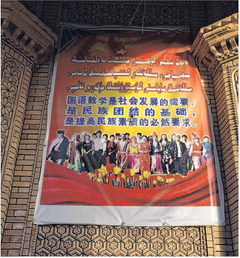
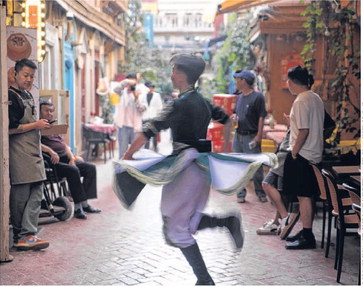
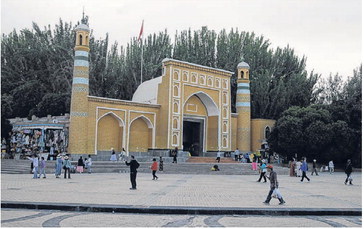
Above, a poster in Hotan in 2019 urged the teaching of Mandarin. Right, a man danced for tourists in Kashgar. Below, the Id Kah Mosque in Kashgar. CLOCKWISE FROM LEFT: GREG BAKER/ AFP/ GETTY IMAGES; BRIAN SPEGELE/ WSJ ( 2)
- Get link
- X
- Other Apps


Comments
Post a Comment