- Get link
- X
- Other Apps
Russia Trapped in Strategic Mismatch
BY YAROSLAV TROFIMOV
Russia faces a fundamental asymmetry as it seeks to beat Ukraine into submission with intensifying airstrikes on shopping malls, power stations, ports and other infrastructure. Kyiv can rely on a secure hinterland beyond its borders—its European neighbors— for economic resilience and for military logistics.
The Kremlin, whose refineries, ports and defense industries are also under attack by Ukrainian missiles and drones, has no such backup. Hits to Russia’s militarized economy translate more directly into damage to the country’s ability to keep the war going.
This lopsided geopolitical setup offsets, to a significant degree, Russia’s advantage in firepower. It has also become a reason driving what Western officials said is a widening Russian campaign of sabotage, hacking and other hybrid operations aimed at intimidating European leaders and voters.
Warning Russia against taking hostilities to North Atlantic Treaty Organization members in Europe was a key message delivered by Central Intelligence
Agency director John Ratcliffe on his recent trip to Moscow, people familiar with the matter said.
Russian officials have long described their war as one against the “collective West,” and not just Ukraine. Russian threats have become increasingly strident this summer, including warnings of military strikes against the Baltic states and even the U.K.
Ukraine’s economy and military effort were funded by $105 billion in new European assistance approved this year, money that came on top of
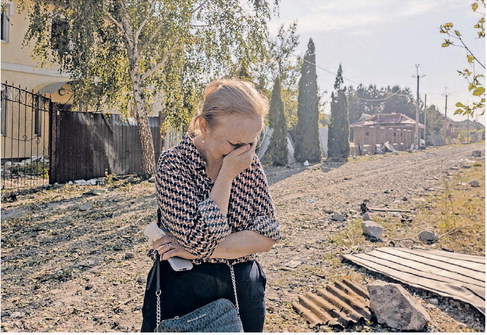
A woman mourns her husband, who died when Russian drones targeted an ammunitions depot in a Kyiv suburb. Over four days, Moscow launched 1,500 long-range drones against Ukraine, of which around 800 were jet-powered, President Zelensky said. A6 SVET JACQUELINE FOR WSJ
vast amounts of aid and arms received from the U.S. and other NATO members since the 2022 invasion. European officials are already talking about another package of comparable size, perhaps to be funded with frozen Russian assets.
Russia, however, has to pay for its own war at a time when its economy is under pressure from Ukrainian strikes and Western sanctions. Two of Moscow’s closest allies, Iran and North Korea, are broke. China is taking advantage of Russia’s predicament to negotiate lower oil and gas prices, and is facing its own economic headwinds.
Russian leaders believe that they need to reverse this imbalance, fast, said Sergey Lagodinsky, a German member of the European Parliament and a Russian native. “They see that Ukraine can survive and can continue to fight because it has access to outside resources and outside solidarity, and that is what they want to cut or damage,” he said.
In one illustration of the disparity in consequences, Russia is struggling with a full-blown fuel crisis because Ukrainian drones have disabled more than one-third of the nation’s refining capacity. By contrast, gas stations are functioning normally in Ukraine because of fuel imports from Europe—even though Ukraine’s own refineries were heavily bombed as far back as 2022.
Ukraine’s military uses logistics hubs in countries like Poland, Germany and Romania, while Ukrainian defense companies have established production lines across Europe, including a plant making ballistic-missile fuel that is under construction in Denmark.
With the exception of Belarus and North Korea, none of Russia’s neighbors, includ-ing its formal defense allies in Central Asia, are openly helping its war effort.
Seen from the Kremlin, the situation is intolerable: NATO countries are inflicting strategic blows on Russia’s economy and military capacity, including its space program, ballistic- missile industry and strategic bomber fleet, with Ukrainian hands—and without paying much of a price.
“There is an asymmetry in terms of the ability to inflict pain and extract costs by Russia from the West for its support of Ukraine,” said Alexan--der Gabuev, director of the Carnegie Russia Eurasia Center in Berlin. Ukraine, he said, has eagerly taken “the war to enemy territory—and it gets a lot of training, advice and material support for these operations behind enemy lines.”
Russia is constrained by the fact that Moscow doesn’t have a Ukraine of its own, an ally that could strike NATO and absorb the retaliatory blows, Gabuev said. Iran and Yemen’s Houthis are the closest approximations— but they have their own priorities focused on the Middle East that are only partially aligned
with Moscow’s, and they possess little capacity to affect European calculations.
This has left Moscow with hybrid warfare—a loose term that includes a recent drone incident involving a Ukrainian cargo plane at Germany’s Leipzig/Halle airport, cyberattacks that disrupted Polish rail services and a series of explosions that struck European defense plants—as a lever to reshape European attitudes. The notion that Russia must hit targets in European nations to win the war is gaining currency in Moscow, said Hanna Notte, Eurasia director at the James Martin Center for Nonproliferation Studies.
“There are hawks on the Russian side who have been saying for a long time that Russia is fighting with one hand behind its back. These voices are becoming louder and will become louder,” she said.
Moscow’s next step on the escalation ladder could be a limited one-off attack—possibly using captured Ukrainian drones, but also missiles—on one or two logistics targets involved in assisting Ukraine on European territory, some officials warned. “One way or another, the Russians will expand the war. Their goal is greater influence over Europe and beyond,” said Oleksandr V. Danylyuk, chairman of the Center for Defense Reforms in Kyiv and a former military and intelligence official.
Marko Mihkelson, the chairman of the foreign affairs committee of the Estonian parliament, said he agreed that Moscow’s strategic goal remains unchanged: conquest of Ukraine and the destruction of European collective security. Yet, he said, there has been no change of Russian military posture along borders from Finland to the Baltic states to Poland—and no indication of preparations for an invasion.
“The picture behind our borders is that all their focus is on Ukraine,” he said. “I don’t think that militarily they are right now both ready and willing to do something here.”
But some worry that could change. Foreign Minister Radoslaw Sikorski of Poland, in a recent essay published by the Economist, warned that Russia’s hybrid attacks on European nations represent a reconnaissance by combat that tests reactions and precedes a larger offensive.
To deter that offensive, he said, Europe must convince Russia “that we are willing to sacrifice more than money to stand up for ourselves.”
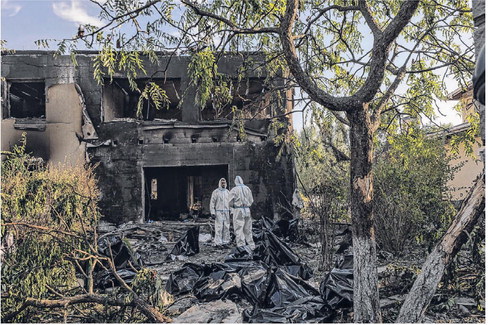
Searchers collect human remains in Ukraine during the weekend after a Russian drones attack left 37 dead. SVET JACQUELINE FOR WSJ
- Get link
- X
- Other Apps


Comments
Post a Comment