The death of reading puts the world in a perilous place
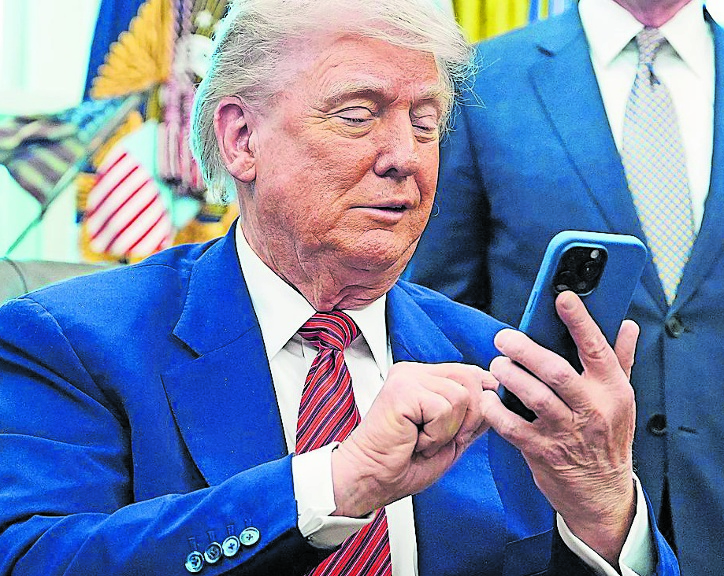
In one of my favourite clips of Donald Trump, the president is asked about the Bible. Which is his favourite verse, a journalist wants to know. “I wouldn’t want to get into it”, Trump says. “The Bible means a lot to me, but I don’t want to get into specifics.” The interviewer presses him on a question that seems easier: does he prefer the Old or the New Testament? “Probably equal,” Trump says.
“I think it’s just incredible.” Donald Trump is not a reader — of the Bible or, we are reliably informed, of any book. According to his former economic adviser, Gary Cohn, “Trump won’t read anything — not one-page memos, not the brief policy papers, nothing.”
Instead, he gets most of his news from screens: Fox News and Truth Social are favourites. This preference explains a lot about the chaos of our present politics.
The president is hardly alone in his allergy to the written word. Reading is in decline everywhere. Most widely cited are a series of reports from universities suggesting that students are increasingly unable to read the books their lecturers assign to them.
According to one professor, his students were “intimidated by anything over ten pages”. And this is more than merely the sort of thing professors have always said about their students.
The statistics are concerning. Literacy, according to a remarkable recent report by the Organisation for Economic Co-operation and Development, is “declining or stagnating” in most developed countries.
A study of the leisure habits of nearly a quarter of a million Americans found that the number who spent time reading on a typical day (including newspapers, magazines and audiobooks) fell by 40 per cent between 2003 and 2023. In Britain, a 2024 survey by the charity the Reading Agency found that more than a third of adults describe themselves as “lapsed readers” — that, is they used to read regularly but no longer do. And the declines in reading are starkest among the young. According to data from the National Literacy Trust, children’s reading rates are now the lowest on record. And though publishers’ profits remain robust, book sales by volume have decreased or flatlined in the 21st century and library use is in steep long-term decline. It has been suggested that the publishing industry is ever more reliant for its survival on a committed hard core of “super-readers”; 80 per cent of books are read by 20 per cent of adults.
It is not hard to guess what is going on. The big culprit is the smartphone, which became widespread in the early 2010s. Smartphones are designed to be addictive, using an array of content-recommendation algorithms, notifications and endlessly scrolling feeds of content to keep your attention fixed almost permanently on the screen. Phones shatter the concentration required for deep reading. And this is far from a problem confined to TV-addicted presidents and distractible students. A few years ago, even the novelist Howard Jacobson admitted: “I can’t read any more as much as I used to. My concentration has been shot by this bloody screen.”
Many of us no longer even read on screens. In recent years, and especially since TikTok took off around 2019, our culture has been deluged by a new medium: shortform video. Where people once used smartphones to read news articles, they use them to spend hours scrolling through a dazzling stream of videos, many of them only a few seconds long. More than 40 per cent of young adults regularly get their news from TikTok.
The decline of reading is about more than the fading of a pleasant hobby. It is one of the most important trends of our time. We are moving from a literate culture based on the written word to a visual one dominated by moving images. The argument of my forthcoming book, The New Dark Ages, is that anyone wanting to understand what is going wrong with our democracy must pay attention to this fact. Many factors shape democracy’s 21st-century troubles, but I don’t think we should be surprised that an age of declining literacy is also one of democratic retreat.
According to the grim statistics supplied by the website Our World in Data, the number of people who have democratic rights declined from 3.9 billion to 2.2 billion people between 2016 and 2024.
Political discourse that was once conducted in print — with its remarkable capacity for sustaining logical thought and extended argument — now takes place in the moronic inferno of social media. In the fragmented, trivialised and angry new world that is being shaped by the smartphone, conspiracy theories and mad ideas spread with terrifying fertility. If our politicians seem lightweights and our public discourse trivial to the point of dysfunction, it is in large part because books and newspapers have been replaced by ubiquitous screens.
Democracy and literacy have gone hand in hand from the very beginning. For almost all of human history, literacy was largely restricted to an elite minority. The power of the autocratic monarchs who ruled Europe before mass literacy rested on their monopoly of knowledge. “Information about the inner workings of the power system was not supposed to circulate under the Old Regime,” writes the historian Robert Darnton. “Politics was the king’s business.”
Cardinal Richelieu, the architect of French absolutism, thought (and most of history’s dictators have tended to agree with him) that learned citizens were dangerous — they would “exhibit pride and assumption” and “would not render obedience”.
The spread of literacy in the 18th century was a powerful catalyst for democracy and a big problem for absolutist monarchs who desired to rule without scrutiny or opposition. As literacy spread and books and newspapers multiplied, ordinary people could read for the first time about the government’s catastrophic finances, disastrous foreign wars and extravagant spending. And more voices were drawn into political debates.
These new readers and writers began to develop increasingly sophisticated and critical ideas about politics. The watchmaker’s son Jean-Jacques Rousseau’s book The Social Contract ringingly announced that “man is born free and is everywhere in chains”, and then went on to argue that political authority was bestowed not by divine right but by the consent of the people.
In Common Sense, the corset-maker’s son Thomas Paine argued against the principle of hereditary power, and for revolution against tyrannical government. It might be going too far to say (as ambitious historians once liked to) that Rousseau and Paine’s books triggered respectively the French and American revolutions. But both works were enormously politically influential. Crucially, both Rousseau and Paine were men whose voices and ideas would have counted for nothing in the age before widespread literacy.
These books were also symptomatic of a new critical attitude that came into being with the spread of literacy. Books and newspapers not only spread information, they change the way we think.
“To engage [with] the written word,” wrote the media theorist Neil Postman, “means to follow a line of thought, which requires considerable powers of classifying, inference making and reasoning.” When you make a written argument you must set out your ideas logically, supply evidence and explain your conclusions. And readers have your arguments fixed in front of them, allowing them to submit them to closer critical analysis. Reading, it’s easy to forget, is a remarkably sophisticated cognitive activity. As the neuroscientist Maryanne Wolf explains, when we read deeply we perform a series of complex mental processes, including “connecting background knowledge to new information, making analogies, drawing inferences, examining truth value, passing over into the perspectives of others ... and integrating everything into critical analysis”. Literacy fosters more critical and abstract thinking, helping us to generalise about the world and to analyse it logically.
Papers cultivated political thought
Observing the spread of print in rural Britain, the Edwardian writer George Bourne noticed that even cheap newspapers were helping to cultivate more sophisticated political thinking in poor communities.
Bourne noticed that newspapers could help a citizen to see “the general aspect of questions which, but for the papers, he would only know by his individual experience from the inside”. “All unawares,” he wrote, “the people fall into the momentous habit of thinking about abstract ideas.” Newspapers and books joined the dots between apparently disconnected events and fragments of gossip, helping readers to see their problems in abstract, systemic and political terms. These new readers were able to consider issues such as unemployment not as inexplicable local tragedies that arrived from out of a clear blue sky but as complex, explicable multicausal issues that affected everyone and required sophisticated solutions.
Certainly, working-class politicians throughout the 20th century were convinced that literacy would be central to their political success. In Britain, JR Clynes, one of the pioneering generation of autodidact Labour MPs, argued that words were the “mighty levers whereby the power of the whole world could be more evenly and fairly distributed for the benefit of my kind”. He was not wrong. It is no accident that democracy as we know it today, in which all adults can vote regardless of sex or class, first arrived in the age of mass literacy in the late 19th and early 20th centuries. It was then that working-class movements, organised and made articulate through print, began to win concessions from their governments in the form of pensions, healthcare, workplace protections and, crucially, voting rights.
“ Where people once used smartphones to read news articles, they increasingly use them to spend hours scrolling through a dazzling stream of short videos
So much of the strength of politics in the 19th and 20th centuries was rooted in reading. In the great heyday of mass literacy, newspaper readership was at near saturation point in Britain and America. At one point the city of New York alone had 17 newspapers.
The whole story of 20th-century democracy, from Watergate to the Pentagon Papers, is inconceivable without print. And this literate environment shaped every aspect of politics. Well into the 20th century, politicians spoke knowing they would be read as well as heard. Parliamentary speeches were often printed in full in the papers. And, once printed, important speeches were subjected to a detailed analysis. When Churchill was a new MP, his maiden speech was reported extensively in The Times and picked over in the press with an excited attention that approached almost the level of literary criticism.
But as reading declines and more people turn to videos for political information, the literate culture that sustained sophisticated argument and rational debate is crumbling. Almost 300 newspapers in the UK have closed in the 21st century. According to one estimate, there are fewer newspapers in Britain than at any point since the 18th century. Many areas of the UK are “news deserts”, where citizens have no access to reliable information about local politics. Studies in America have found that when newspapers disappear citizens vote less, and those who still vote do so more strongly along partisan lines.
This shift away from a literate culture is even changing parliament. An analysis in The Economist found that the length and sophistication of speeches made in the House of Commons has declined steadily since the 1970s. In 1938, the average speech in parliament was nearly a thousand words long.
The length of speeches started to “shrink dramatically” after 2015, “when video functionality appears on Twitter”. By 2024, the average speech was 460 words, as MPs increasingly spoke not for the benefit of newspaper reporters but for clips on social media.
What the increasingly ubiquitous medium of short video rewards is not detailed argument and reasoned debate but visual dazzle: conflict, spectacle and emotion. If you want to succeed in 21st-century politics you must become a master of social media and especially of TikTok. On a hyper-competitive video platform where some users may scroll past 260 videos in just over half an hour, there is little space for nuance. Strong imagery and simple solutions do well. Speeches, ideas and complicated arguments do not. Unsurprisingly, there is evidence that TikTok usage seems to correlate with an increased vote share for the far right and populist parties. In both Britain and America, populist candidates easily outperform their over-earnest, speechifying centrist rivals on short-video platforms.
Videos by Reform UK’s leader, Nigel Farage, attracted almost 14 times as much engagement as those by his mainstream rivals. Restore’s leader, Rupert Lowe, does exceptionally well on social media.
Dangerous rise of the personalists
In the new politics being forged by the smartphone, spectacle comes before thought. Donald Trump is a master of screens as well as an addict of them.
Officials are appointed not for their ideas or policy experience but according to whether they look the part. The New York Times has reported that Trump spends time “watching videos of potential senior staff members to see how they look”. Trump likes his generals to look like they come from “central casting”. Often he wants to know not whether a policy will be effective but how it will look on screen.
On X, clips of American strikes in the Iran war were set to dramatic music and interspersed with clips from films. It’s a disastrous and expensive war, but it looks cool.
Most dangerous for democracy is the fact that screens love personalities. If you want to win people over in print you will need to make an argument and supply evidence. If you want to persuade on screen, charisma is more important. The greatest threat to democracy in the 21st century comes not from an ideology such as communism or fascism but from a political tendency sometimes known as “personalism”
— the domination of a country’s politics by a single charismatic personality. Donald Trump is an obvious example. Other personalist leaders include Narendra Modi of India or Recep Tayyip Erdogan in Turkey.
Nayib Bukele, the leader of El Salvador and the self-proclaimed “world’s coolest dictator”, runs a slick TikTok filled with images of prisons, soldiers and his glamorous family. He is the most followed world leader on TikTok.
Screens allow strongmen to get close to their followers, to appear in their lives as an everyday presence, even a friend. The aim is not to persuade through rational argument or effective policy but to draw viewers into a cult of personality.
This is a dangerous direction for democracy. At best, this hyper-personal, chaotic and emotional new politics is ineffective at producing good outcomes for citizens. At worst it offers dangerous opportunities for charismatic demagogues. Charles Duncan was another of the pioneering and highly literate Labour politicians of the early 20th century. As he remarked, “the unread man has a narrow outlook, and easily goes astray; he is the sport of political tricksters and the tool for all knaves”.


Comments
Post a Comment