Putin Looks to FSB Hardliners to Keep His Wartime Elite in Line
Translate
5:51
Takeaways by Bloomberg AI
Many of Russia’s elite increasingly fear the Federal Security Service is out of control as President Vladimir Putin tasks the agency with maintaining his grip on power amid growing unease over the war in Ukraine.
A terrorism charge against billionaire Telegram co-founder Pavel Durov is the latest indicator of an intensifying wave of repression by the service, known as the FSB, according to people close to the Kremlin, asking not to be identified discussing sensitive issues.
While the president has long ruled by balancing between security hardliners and more moderate, economy-focused groups among his officials, many within Kremlin circles feel that Putin now leans consistently toward advocates of harsher control over business and society, the people said.
That’s stirring tensions as the FSB expands its reach with no obvious checks on its power, while senior officials including Sergei Kiriyenko, Putin’s powerful domestic policy chief, are losing influence, according to assessments of people close to the Kremlin and the government. Kiriyenko has drawn blame recently for setbacks in Russia’s political operations in Armenia, Moldova and Hungary.
“The FSB has become the management company of the country,” said Andrei Kolesnikov, a Moscow-based political analyst. “The political administration, the Foreign Ministry, and the financial-economic bloc have been reduced to mere technical staff serving decisions made with a secret-service bias.”
A bomb attack in central Moscow last weekend has likely only strengthened the FSB’s arguments with Putin for tighter security. That’s left other Kremlin factions with little ability to resist a tougher crackdown despite concerns it could erode the president’s public support that has already slipped to its lowest since the 2022 full-scale invasion of Ukraine began.
Kremlin spokesman Dmitry Peskov didn’t respond to a request for comment.
Putin, a former KGB agent and FSB chief, is placing his faith in his security service to safeguard his rule as the war becomes more visible to ordinary Russians. Ukrainian strikes on oil refineries, defense plants and logistics warehouses extend deep inside the country, undermining Kremlin claims that he has the situation under control in the fifth year of a conflict that shows no sign of ending.
Russia’s military has incurred enormous battlefield casualties, while its economy is straining under the pressure of massive state spending, high real interest rates and negligible growth amid unprecedented Western sanctions.
In particular, the FSB’s Second Department, responsible for combating terrorism and upholding Russia’s political order, has been given free rein to investigate anyone with little or no accountability, according to three of the people.
It’s behind the push to charge Durov with terrorism as part of efforts to restrict Telegram, those people said. That’s despite objections from senior Kremlin officials responsible for managing September’s parliamentary elections, who warn a clampdown on the popular messenger risks a backlash from voters.
Durov, who has lived outside the country for years, dismissed the charge on his Telegram channel, saying Russia had declared him a terrorist “for refusing its demands for mass surveillance and censorship.”
Even relatively marginal critics have been ruthlessly pursued. Ilya Remeslo, a former pro-Kremlin blogger who turned against Putin, was sent to a psychiatric clinic after being arrested in St. Petersburg on charges of spreading “fake news” about the military, the state-run Tass news service reported July 26.
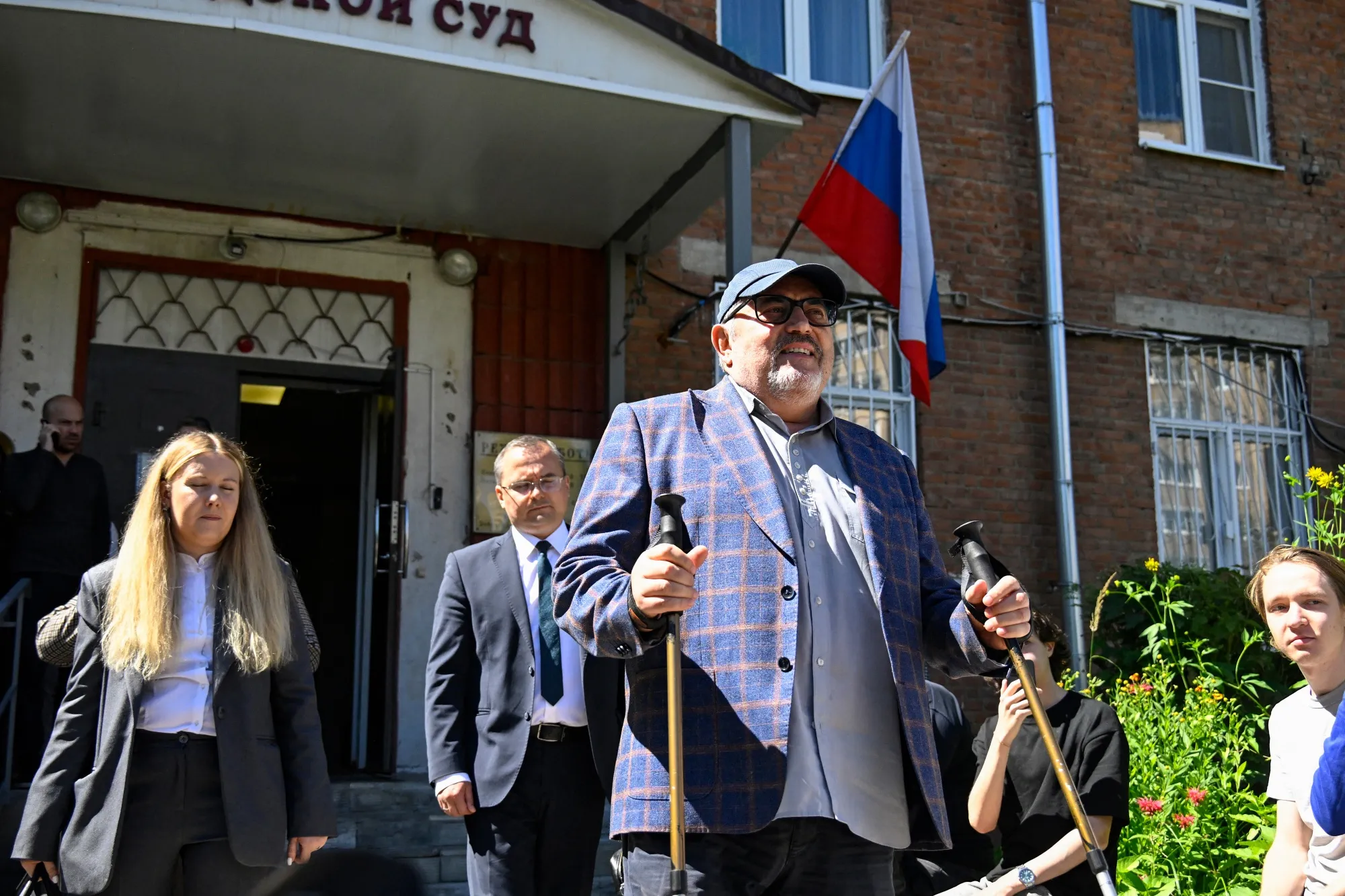
Boris Nadezhdin, an anti-war politician who was barred from challenging Putin in the 2024 presidential election, was convicted of “extremism” for displaying a photograph of the late opposition leader Alexey Navalny. He announced this week that he’d fled to France after being declared a “foreign agent.”
Business tycoons are also being targeted by investigators and prosecutors amid a sweeping wartime asset grab that’s redistributing properties to people close to or loyal to the authorities.
Russia’s cultural and science sectors haven’t escaped scrutiny, either.
The Second Department has opened cases against dozens of physicists and aerospace researchers on “treason” charges for participating in past state-sanctioned international symposiums. It maintains unofficial blacklists of actors, musicians and directors deemed to be unpatriotic, imposing ideological conformity using laws against “extremism” and “discrediting” the military.
Putin on Tuesday signed new legislation to punish anti-war Russians who’ve fled into exile and been convicted in absentia. Their assets in Russia will be frozen, they’ll be banned from using state and banking services online, and they’ll be refused the right to renew their passports abroad.
The Second Department has a track record of targeting Putin’s most prominent opponents. The US sanctioned its chief, General-Colonel Alexey Sedov, over the 2020 poisoning of Navalny, the UK imposed similar measures on its agents for poison attacks on Vladimir Kara-Murza, and the department was tracking former Deputy Prime Minister Boris Nemtsov prior to his 2015 assassination on a bridge next to the Kremlin.
Sedov, 71 enjoys direct access to the president, who appointed him in 2006. Described as a calm and capable manager with a passion for fishing, he began his KGB career in Leningrad, later St. Petersburg, a few years after Putin, and headed Russia’s Federal Tax Police Service in the 1990s.
He was at the forefront of arguing for mobile internet restrictions on security grounds earlier this year that sparked widespread public anger as Russians lost access to digital services and businesses complained of huge losses.
Russia’s elites are increasingly alarmed at the inability of the system to deal with mounting challenges linked to the war, and there’s no sign Putin’s willing to make concessions, Tatiana Stanovaya, a senior fellow at the Carnegie Russia Eurasia Center, wrote in a July 27 commentary.
“The fundamental issue is a feeling that the Russian leadership has lost its grasp on reality,” she said. “That Putin’s fixation on subjugating Ukraine has made effective governance significantly harder.”
The repressive atmosphere is spreading among both the elites and Russia’s middle class, said Ella Paneyakh, a sociologist and research fellow at the New Eurasian Strategies Centre think tank.
“People are all scared, because no one knows who they’ll come for,” she said.


Comments
Post a Comment