We’re in a heatwave, so why is a ‘cold blob’ in the Atlantic causing so much concern?
I
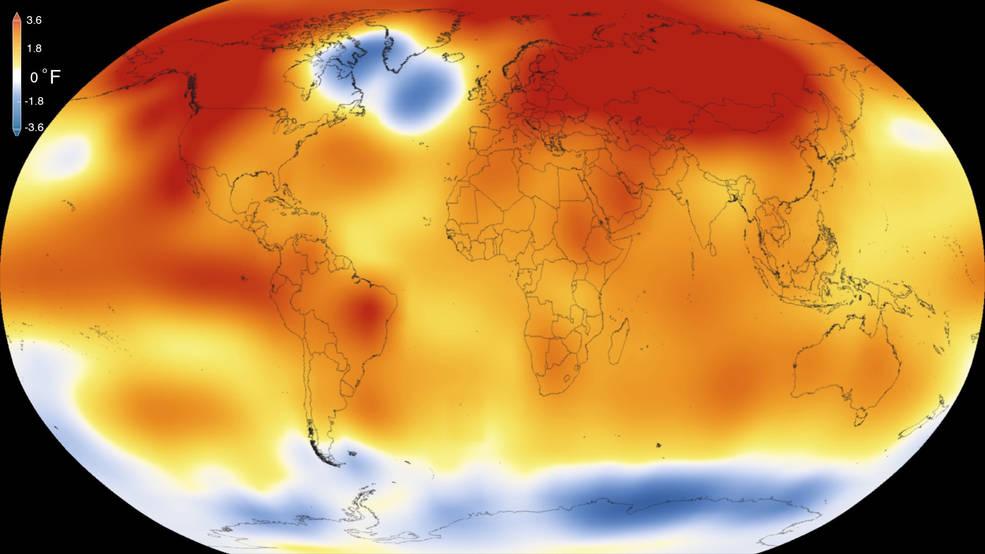
t may sound strange considering this summer’s multiple unrelenting heatwaves, but a less-talked-about anomalous climate phenomenon is steadily gaining attention: a giant cold patch has formed in the North Atlantic Ocean.
Dubbed the “cold blob” or “warming hole”, this vast tranche of water in the subpolar North Atlantic south of Greenland is the only place in the world to have cooled significantly since the 19th century. In fact, it has dropped by nearly 1C since 1900; the plunge in temperature first started ringing alarm bells in the scientific community around a decade ago due to its swiftness and severity.
Not only could the cold blob itself have a significant impact on our climate and weather systems, but its very existence potentially suggests that something far more worrying is afoot in our oceans, according to a paper published in May.
This is a complex and nuanced area of science. Oceanographers and climate scientists have speculated that two different factors could be causing this level of cooling: a combination of changing ocean currents and changes in surface heat fluxes. However, they are “debating the relative importance of the two mechanisms”, says Flavio Lehner, a climate scientist and assistant professor at Cornell University. Consensus has yet to be reached.
The latter would mean that the cold blob is cold mainly because more of the water’s heat is passing from the ocean’s surface into the atmosphere. The former is all to do with something called the Atlantic meridional overturning circulation (Amoc), a major system of ocean currents that moves water around the world – and it’s largely this notion that is sparking major concern.
In the aforementioned study, published in Geophysical Research Letters earlier this year, a team led by Potsdam University’s physics and oceans professor Stefan Rahmstorf concluded that ocean heat transport – ie, the current system – not surface fluxes, was to blame for the cold blob.
A brief science lesson before we go further: not all water is created equal, at least not when it comes to weight. “It’s all about buoyancy – what floats and what sinks,” says Dr Lee de Mora, a marine ecosystems modeller at Plymouth Marine Laboratory. Warm water floats and cold water sinks; fresh water floats and salty water sinks.
“So we have these two things, we have temperature and salinity, and in different combinations, they either float or sink,” says Dr De Mora. “This whole question is about density.” Cold water can only get so cold before it turns to ice, which then floats – salinity is key to how water circulates.
The Amoc is a kind of massive, intricate, global conveyor belt that transports water around. Really salty, warm water travels northwards from the equator and the Caribbean via the Gulf Stream. As it gets cooler, it starts to sink, going downwards, before heading south along the eastern seaboard and then down towards the Southern Ocean.

“The Amoc is one of the two main engines of global circulation, which is why it’s so important,” explains Dr de Mora. “You get warm Caribbean water coming north, it emits that heat to the atmosphere and keeps us nice and warm here in Europe, and then that water sinks and heads southwards.”
But somewhere along the way, that current system appears to have slowed down or changed – hence the cold blob. And, somewhat counterintuitively, it looks like climate change is a key suspect in this equation.
The warming effect of extra CO2 in the atmosphere has resulted in the Greenland ice sheet starting to melt. This water is very cold, but it’s also fresh water, rather than salty – so it floats. “It just sits at the surface and it actually stops that water from sinking; it stops the sinking part of the engine,” says Dr De Mora “So that’s where you get this slowdown in the global circulation. That patch of fresh, cold water sits there in the North Atlantic and blocks water from getting to it.”
That’s what’s so scary about the cold blob – it has this huge impact on everything around it
Because the cold blob is so big, it also affects the air above it. The jet stream, a fast-flowing current of air flowing from west to east, hits the cold blob and is forced to go around it. “That’s when you get these heat dumps and cold snaps, where it hits the bottom and then it creates a wave in the jet stream that passes over Europe,” says Dr De Mora. “That’s what’s so scary about the cold blob – it has this huge impact on everything around it.”
In the shorter term, the cold blob could, despite its name, lead to more heatwaves in the UK, says Dr Dafydd Gwyn Evans, a senior research scientist in physical oceanography at the National Oceanography Centre. He’s been part of a paper that related the cooling in the subpolar North Atlantic to extreme European heat waves. “Essentially, the gradient in temperature of the ocean affects the path of the jet stream and how far north or south it flows over the continent,” he says. “The tendency is for us to have more extreme summer heat waves with this cold blob in the subpolar gyre.”
However, in the longer term, there is the potential for the climate in northern Europe to get much colder due to the blob. “You can compare the weather and climate in other regions at the same latitude as us,” says Dr Evans. “To the west, there are these notoriously cold regions of Canada, right? The idea is that the reason we have such a mild climate here is because of all this warm water that’s transported north by the Amoc. And, in the absence of that warm water and a cooling of the subpolar North Atlantic, we might expect that our weather could become more like eastern Canada.”
The very question of whether the Amoc is “weakening” is controversial. That’s because there simply isn’t enough data to say for sure yet – direct observations of the ocean have only been recorded for the past 25 to 30 years, and experts say we need at least 60 years’ worth of data to come to a definitive conclusion.
The recent study, for example, primarily used indirect observations – so-called “reanalysis data” from a computer model fed with real-world measurements wherever they were available. “It’s in many ways the best we can do if we want to look into the time before satellite measurements and ocean moorings, so before about 1980 – but it comes with sizable uncertainties,” Lehner points out.
Dr Evans says that scientists who look at direct observations of the ocean would be more “cautious” when it comes to making sweeping statements about whether or not the Amoc is significantly weakening.
However, all of the big climate models, such as those from the IPCC reports, are universally predicting that the Amoc will weaken this century. “There is that conflict between: this is what the models tell us; this is what we expect from the science; and this is what the observations are doing,” says Dr de Mora. “It is still an open question, but we are almost certain that the Amoc will weaken this century.”
Within that assumption rumbles another debate. There are essentially two fiercely opposing “camps” of scientists, according to Lehner, “one that is increasingly concerned that the Amoc might collapse before long and one that thinks it is more stable.”
The consequences of an Amoc collapse would be so dire that it’s not worth waiting to find out
The first scenario would “objectively be very disruptive for humans and ecosystems, but how close we are to this is uncertain,” he says. The most recent IPCC report said that a sudden “collapse”, rather than a gradual decline, was a low-likelihood, high-risk scenario. The effects of the former would be severe, though: massive heat waves, rapid changes in sea levels rising along the North Atlantic.
The consequences could extend far beyond climate patterns – “shifts in plankton communities could ripple through the food chain, affecting fish stocks, seabirds and marine mammals,” writes Helen Findlay, a biological oceanographer at Plymouth Marine Laboratory. “Fisheries that currently support coastal economies could become less reliable or collapse altogether.”
It would also make climate change worse. Currently, the system of water sinking actually removes a huge amount of CO2 from the atmosphere, transferring it to the deep ocean, where it will stay for thousands of years. A collapsed Amoc equals less sinking water, equals less carbon being removed by the ocean, equals even more emissions accumulated faster in our atmosphere.
While scientists may not agree on the severity of the risk that a total Amoc breakdown is imminent, they are united when it comes to recognising just what a big threat the possibility poses.
“On a personal level, I think the consequences of an Amoc collapse would be so dire that it’s not worth waiting to find out,” warns Lehner. “Reducing greenhouse gas emissions is the only known way to avoid the collapse, so from a risk reduction perspective, we have enough information to take this scenario seriously.”
As Professor Findlay puts it: “If we wait for the language to become unambiguous, we may find that the system we are describing has already changed beyond recognition. The ocean is already telling us something important. The question is whether we are prepared to listen, and act, while there is still time.”


Comments
Post a Comment