- Get link
- X
- Other Apps
U.S. Biotechs Step Up Secrecy To Beat Chinese Drug Copycats
Companies use new playbook to stay ahead of efficient pipeline overseas
BY XAVIER MARTINEZ
Steve Potts develops medicines for hard-to-treat cancers. Just don’t ask what, exactly, he is working on. If word gets out, he fears a Chinese company could beat him to market.
Potts’s company, whose team shepherded 13 drugs through Food and Drug Administration approval, is one of a growing number of biotechs going to extreme lengths to stay secret. He won’t pitch venture-capital firms. He hasn’t presented at academic conferences. The company, Breakthru Medicine, is taking money only from a handful of trusted, high-net-worth individuals and universities.
For decades, young biotechs broadcast their science to attract investment. Today, more are going dark to keep rivals, many of which are in China, from replicating their research and doing
studies in humans faster than they can.
“You have to be much more thoughtful with how much you’re talking about what you’re working on,” Potts said.
Today, when a drug company publishes a successful trial at a major conference, they run the risk that a firm in China replicates their work, launching competing trials using the same science. Re--search in China can in some cases move twice as fast and cost half as much as within the U.S. That has allowed Chinese biotechs to become a bigger threat to the U.S. industry and has caused drugmakers big and small to rethink how much information they share about promising new science.
The number of early-stage trials run in China in 2025 was
about five times as high as a decade prior, while the number of similar trials run in the U.S. stagnated, according to lifesciences firm Norstella. The number of so-called fast-follower drugs from China shows no sign of slowing—growing by a factor of 15 from 2015 to 2025, according to Norstella.
“Fast followership is a real concern,” said Priya Singhal, Biogen’s head of development. She said Chinese biotechs have “gotten very good with pretty well-known targets—in bettering them, in really getting more precise.”
Even large companies have tight controls when doing clinical trials with partners in China. Biogen doesn’t share any proprietary information, beyond what’s required by Chinese regulators.
For smaller biotechs, the fast-followership dynamic creates a paradox. Pitching dozens of investors—the traditional path to funding— spreads proprietary science to exactly the audience that can leak it. Staying secret limits companies to small, private capital pools that are hard to access without connections.
“We used to get by in an imperfect system because the venture world would capitalize a good idea,” said Karen Knudsen, chief executive of the Parker Institute for Cancer Immunotherapy. But now, instead of wanting to see a promising idea before studies begin, she said, investors want to see proof that a drug might work in patients, which is easier to get from China where trials move faster.
That led bigger companies to buy some of that science from China. Big drug company executives said they are considering doing deals for earlystage drugs from China more than ever before.
Congress is trying to choke off some of the investment U.S. companies are making in Chinese firms. Lawmakers introduced a bill last month to require investments in Chinese drugmakers to be screened by the Treasury Department, which has the potential to stop certain deals from getting done. Some lawmakers are trying to change regulations so the FDA can’t accept clinical- trial data from China.
After Novo Nordisk published
landmark results in February 2021 showing strong results for its weight-loss drug semaglutide, at least 16 Chinese programs targeting the same mechanism filed for clinical-trial approval or dosed patients in China within 18 months, according to biopharma market-intelligence firm Sleuth, and at least 62 such Chinese programs have launched through June 2026.
Many ended up back in Western companies’ hands: 13 programs were licensed back to U.S. and European pharma giants—including to Novo Nordisk, which bought a Chinese version of a drug program built on its own discovery.
A similar cascade hit oncology in late 2023, when Amgen presented data showing it could target a hard-to-treat protein on small-cell lung cancer cells. A Chinese company started laying the groundwork for a competing trial within six weeks. At least 10 programs entered clinical development in China targeting the same protein within 18 months.
The race has reached genetic medicine, some of the most advanced science in labs today. Cambridge, Mass.-based Beam Therapeutics developed an experimental treatment for a rare inherited disease that damages the lungs and liver, dosing its first patient in 2024. A former employee joined Shanghai-based YolTech Therapeutics in 2022, building a drug with the same exact target, using the same technology. The former employee said she didn’t work on Beam’s drug while at the company.
YolTech’s treatment won U.S. regulatory clearance for a late-stage trial in March—two months after Beam struck its own deal with the FDA to speed its drug toward approval. Last month, a San Diego biotech company licensed YolTech’s drug.
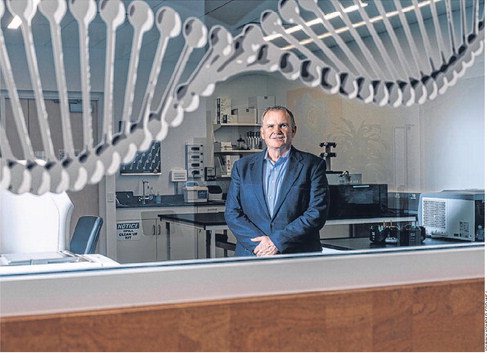
Steve Potts’s Breakthru Medicine is among the biotechs that have clamped down on sharing proprietary science. JOHNNY KOMPAR FOR WSJ
- Get link
- X
- Other Apps


Comments
Post a Comment