Cockroaches Put India Inc. on Notice
Translate
7:02
Takeaways by Bloomberg AI
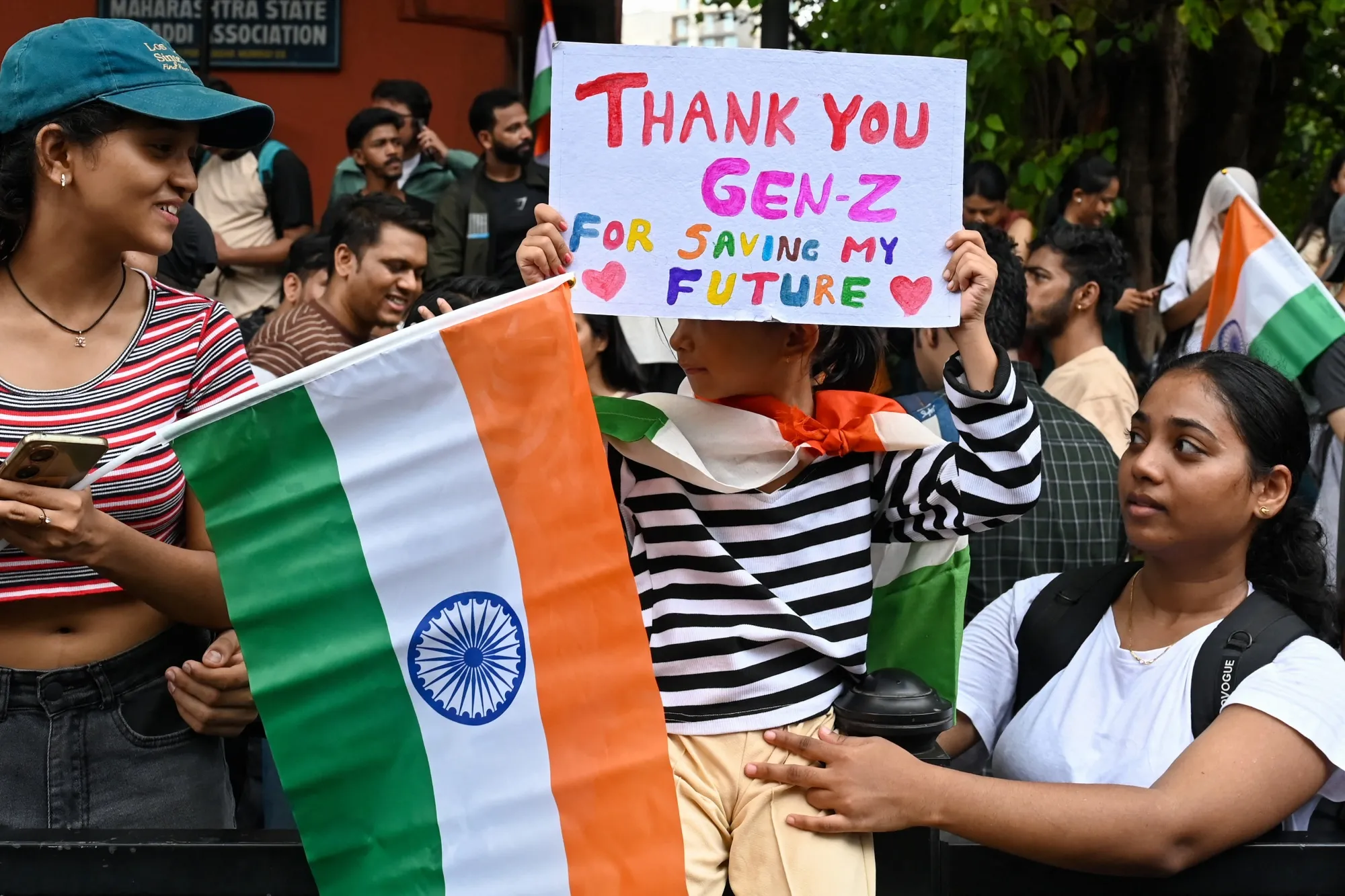
India’s self-styled “cockroaches”— the youth movement protesting over leaked exam papers and systemic corruption — have dimmed Prime Minister Narendra Modi’s aura. They’ve also put the local business community on notice. And now that Modi has been forced to beat a rare retreat, there’s no telling where public anger will turn next.
This leaves India Inc. in a bind. It has backed Modi to the hilt for the last 12 years, turning a blind eye as politics took an authoritarian turn, democratic institutions frayed, and religious polarization fractured social cohesion. The reward for support has been handsome indeed. Corporate taxes? Slashed. Labor and environment codes? Relaxed. Industrial subsidies? Granted. A chance for large conglomerates to scoop up bankrupt corporate assets on the cheap? Achievement unlocked.
As I have noted before, the aggregate net income of listed Indian firms is approaching a record 6% of gross domestic product. Yet their capital expenditure has remained flat, hovering below 4% of GDP. Most business owners are holding back on new investments because of a fatal loop of their own making. The good jobs and growing wages that create robust purchasing power are the very things they are failing to generate. And now Gen Z is making its displeasure known.
Can captains of industry hold on to their profits if the administration bends further under popular pressure?
By sacrificing his education minister over rampant corruption in examinations, Modi has shown that his strongman image is not bulletproof. The youth have delivered the first blow, and they may not be done yet. If the government backtracks on its assurance to not prosecute the protestors detained by the police, agitations may resume.
Besides, students aren’t the only ones who are angry. Farmers are agitating against the proposed India-US trade deal, which will open the local agricultural market to American produce. Car owners are up in arms over the decision to make gasoline blended with 20% bioethanol as the default option at the pump. Older vehicles can’t handle the fuel, yet instead of acknowledging the backlash over reduced mileage and increased maintenance costs, automakers would rather fight their consumers in courts — and hope to sell more of newer models.
Digitization is also turning the public against both the government and corporate India. The state is using centralized digital systems to reduce its own accountability, canceling welfare payments over biometric mismatches and spelling errors while exempting itself from much of the new data protection law. Those concerns around exclusion now extend to elections, with fears that millions of voters are being quietly removed from electoral rolls. Meanwhile, companies harvest consumer data with impunity, showing scant regard for its safety. The result is a crisis of trust: The poor risk losing basic entitlements, the middle class suffers identity theft and relentless banking fraud, and voters face disenfranchisement.
Corporate elites everywhere have a natural tendency to benefit from political access. In India, large conglomerates have used their proximity to power to divide up large swathes of the local market as monopolies or duopolies. Under the guise of curbing a domestic duopoly in aviation, India is discussing a policy change that would let private airport operators run airlines, Bloomberg News reported last week — a move that threatens to ruin any hope of genuine competition through obvious conflicts of interest.
Lacking proprietary technology or world-beating products, businesses rely on the state’s apron strings. In fact, they tug at them harder when the environment turns unfriendly, like when the Trump administration imposed punitive tariffs on the country last year. A corporate push for 70- to 90-hour workweeks led to newly revised labor rules, which legitimize 12-hour factory shifts.
This low-investment, high-extraction playbook is creating a bifurcated economy. A handful of players widely considered to be the leading luminaries of the national team — Mukesh Ambani, Gautam Adani, the Tata Group, and Sajjan Jindal of the JSW Group — are deploying capital into infrastructure, data centers, electric vehicles, and a rudimentary semiconductors supply chain.
But the broader corporate class is in retreat. Millennial and Gen Z owners of successful mid-tier firms are getting out of the game altogether by selling out to private equity. They want to park their money in family offices; let someone else create the hard assets.
Last week’s events must give even the winners of the last 12 years pause. It was one thing to toe the government’s line when it was safely anchored to Modi’s perceived invincibility. But the cockroach movement has exposed fissures that should trouble the government. Indian business history shows that when an authoritarian regime fractures under economic stress, the pecking order among corporate incumbents changes.
That’s what happened in 1977. A decade of economic ennui, militant trade unionism, currency devaluation, the 1973 oil shock, and Prime Minister Indira Gandhi’s 21-month-long abrogation of civil liberties culminated in a regime change. It’s impossible to predict if similar conditions 50 years later — high energy costs, a stumbling currency, and stifling of dissent — will reprise the same political outcome. Polls next year in Uttar Pradesh, India’s most-populous state, will act as a weather vane for the general election in 2029.
Now is the time for the capitalist class to adopt a new playbook and beef up their balance sheets by tapping the $4 trillion in stock-market wealth created during Modi’s reign. Ambani is launching the initial public offering of his digital empire, the first major IPO for his group in almost two decades. Adani has raised fresh equity in his flagship company. Second-tier tycoons should follow suit and convert today’s lofty valuations into permanent equity capital and use the money for a reboot. Relying on state contracts, monopolistic control, data harvesting, and suppressed wages is no longer a strategy. That model may not survive an encounter between a retreating government and young graduates battling 40% unemployment.
India’s business community may think it can ride out a possible political storm from their boardrooms. But if Modi’s political legitimacy erodes, corporations will have to deal with the fallout, and the cockroaches may just scatter away.
More From Bloomberg Opinion:
- Why the US Dropping ‘Indo’ From Pacific Matters: Mihir Sharma
- Populist Strongmen Are Winning the Long Game: Adrian Wooldridge
Want more Bloomberg Opinion? OPIN <GO> . Or you can subscribe to our daily newsletter .
This column reflects the personal views of the author and does not necessarily reflect the opinion of the editorial board or Bloomberg LP and its owners.



Comments
Post a Comment