China Tech’s Deepening Valuation Slump Fails to Win Back Buyers
Translate
4:59
Takeaways by Bloomberg AI
The selloff in China’s biggest internet firms has driven some valuations to record lows but investors say a recovery still looks a way off given the many headwinds they face.
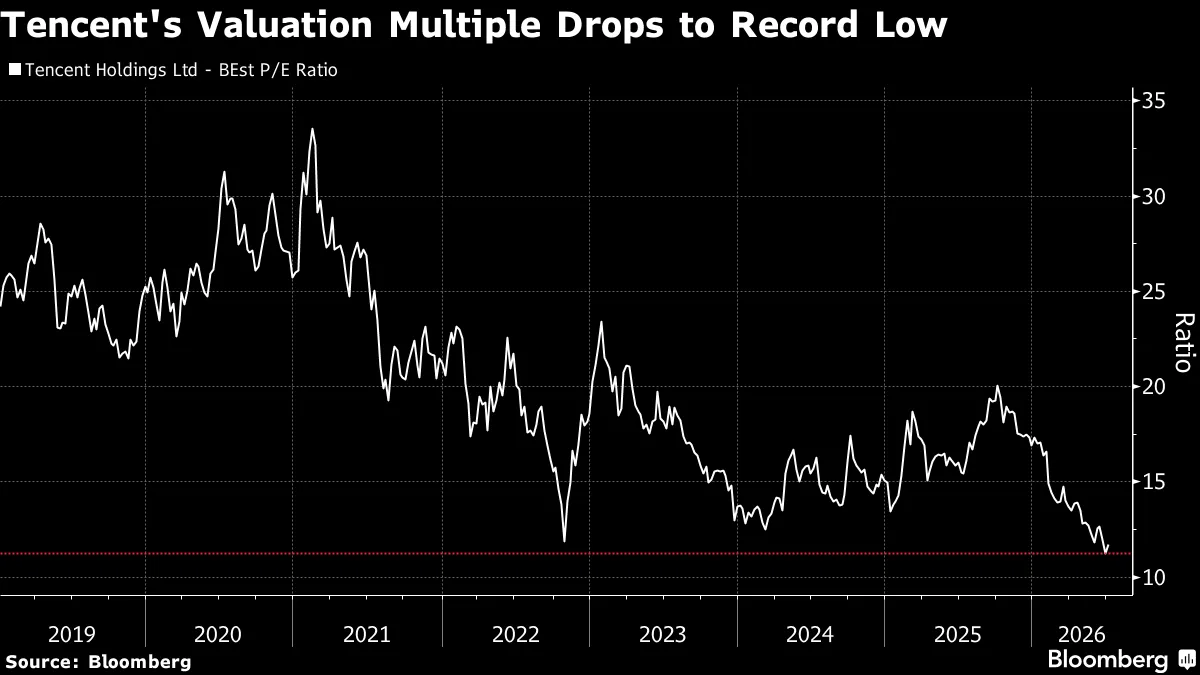
The 27% slide in Tencent Holdings Ltd.’s shares this year has pushed down its price-earnings ratio to an all-time low of 11 times, below that of Hong Kong-based utility CLP Holdings Ltd. Alibaba Group Holding Ltd.’s stock tumbled more than 20% in June alone, putting its valuations at the lowest in almost a year.
Investors have been selling out of China’s largest technology stocks due to concern the companies will fail to gain sufficient returns from their spending on artificial intelligence, while the nation’s sluggish economic growth is weighing on businesses that rely on mass consumption. Analysts have slashed earnings forecasts for Hang Seng Tech Index constituents by more than 20% in the past year, according to data compiled by Bloomberg.
“It’s never a good thing for companies to see that much earnings per share downgrades — very difficult to perform under that kind of environment,” said James Wang, head of China Strategy at UBS Global Research in Hong Kong. Investor attention remains firmly on alternative sectors such as hardware tech that are delivering far stronger earnings growth, he said.
The investor exodus from China’s flagship tech firms such as Tencent, Alibaba, Baidu Inc. and Xiaomi Corp. has accelerated in recent months after their March earnings season offered scant proof that their ambitious AI investments may pay off in the near term. They also suffered as fresh data deepened concerns over the nation’s weak consumer sentiment.
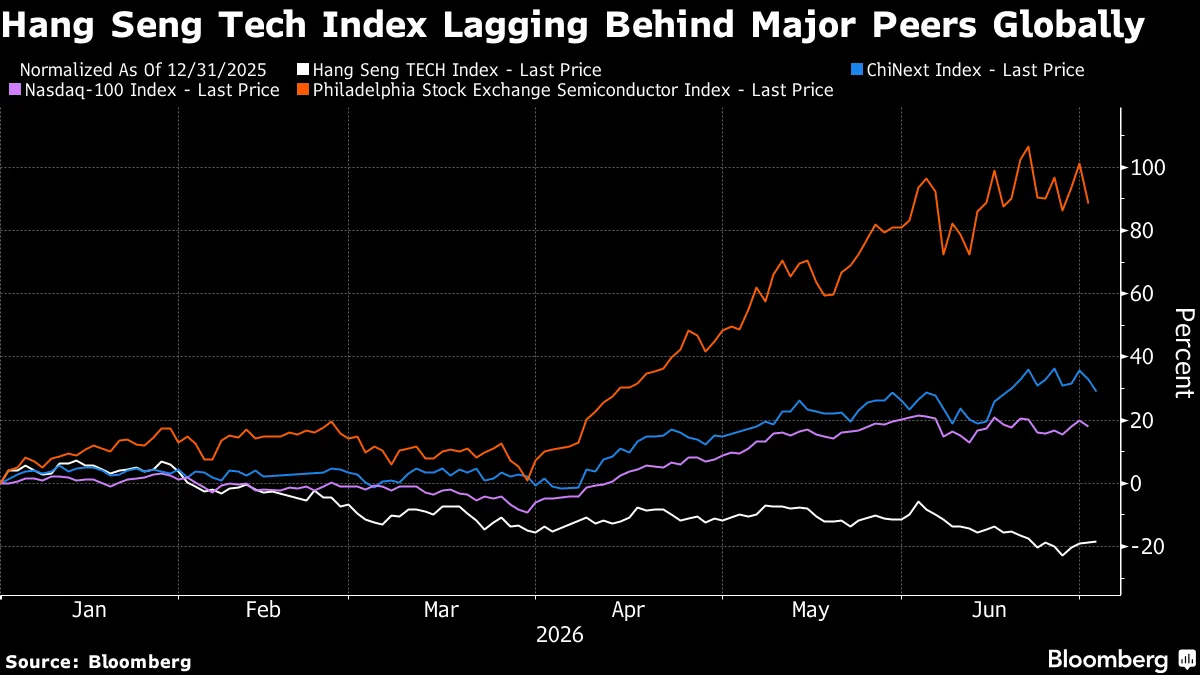
Alibaba and Tencent have lost a combined $318 billion of market value this year, dragging down the Hang Seng Tech Index by 18%, among the worst-performing tech gauges globally. That contrasts with a 26% gain in the hardware-heavy ChiNext Index and a 16% advance in the Nasdaq 100 Index.
The positioning of most China tech firms in the global AI buildout means they are vulnerable to losses, said Matthias Scheiber, a senior portfolio manager at Allspring Global Investments in London.
“If you think about where China sits in AI, it is probably sitting on the affordable end of the AI pool and that’s the one where the biggest competition, the biggest pricing out and the biggest difference between winners and losers because there will be one winner and a lot of them will be losers,” he said.
Tencent in June started testing a new AI assistant for its messaging app WeChat, known as Weixin in China, triggering some concerns about potentially shrinking margins. The additional cost may be equal to about 5-to-17 percentage points of Tencent’s fourth-quarter operating profits, according to estimates from Goldman Sachs Group Inc.
Not everyone is bearish. Some analysts say valuations are starting to get too cheap for investors to ignore.
“We’re not calling it to reverse anytime soon, but for China internet, there’s very big AI growth angle that seems to be underestimated or underwhelmed by investors,” said Alex Liu, head of Greater China Internet and Media research at BofA Global Research in Hong Kong. “For Tencent, we think investors may be focusing too narrowly on direct AI monetization and overlooking the broader value AI can create across its ecosystem.”
Analysts point to another negative facing the sector: a number of investors are selling their shares in the companies to raise funds to spend on AI hardware stocks in South Korea and Taiwan.
“I don’t know what needs to change for investors to unwind this popular trade,” UBS’s Wang said. “Earnings growth has got to be one of those.”
“On average it still looks attractive to us, but the Internet sector still is one of the most crowded,” he said. “In the very near term, they could still be used as a funding source for some of the investors looking to chase the hardware tech.”
Top Tech Stories
- Kioxia Holdings Corp. has started shipping samples of its next-generation flash memory chips to AI data center operators, seeking to gain ground in the lucrative business against rivals.
- Alibaba Group Holding Ltd. joined a $2 billion financing round for Kuaishou Technology’s Kling AI, valuing the creator of one of China’s most popular generative video services at about $15 billion before the investment.
- Crusoe, the data center upstart with contracts to supply AI computing power for the likes of Meta Platforms Inc. and Oracle Corp., is in talks to raise about $3 billion in a funding round that may triple the company’s valuation, people familiar with the situation said.
- Tesla Inc.’s vehicles sales beat Wall Street’s modest expectations by a wide margin, gaining in a slower-growing global market for plug-in cars.
- Meta Platforms Inc. is developing plans for a cloud infrastructure business that will sell access to AI computing power and models, according to people familiar with the matter. SoftBank and its telecom unit will also rent computing resources to US firms, the companies said on Thursday.
- Blackstone Inc.’s private equity fund for wealthy individuals delivered its strongest-ever monthly performance in May, propelled by its investment in artificial intelligence darling Anthropic PBC.
- Anthropic PBC is in talks with Samsung Electronics Co. to be a manufacturing partner for a custom artificial intelligence chip, the Information said, citing people familiar with the plan.
(Updates prices in second and sixth paragraphs, and adds top tech stories after last paragraph.)



Comments
Post a Comment