Can Wall Street keep turning a blind eye to Trump’s enrichment?
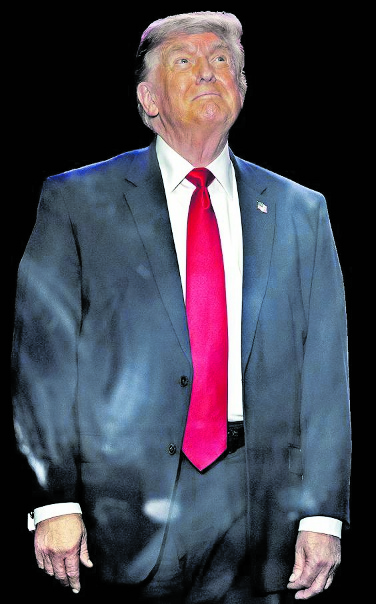
‘‘ Wall Street executives have been quietly holding their noses at the smell emanating from President Trump and his family’s self-enrichment in office.
However, a filing showing that Trump has made at least $2.2 billion since his inauguration in January last year has provoked some cautious expressions of outrage.
After the report was published by the US Office of Government Ethics, Lloyd Blankfein, the former chief executive of Goldman Sachs, took to social media to call out alleged selfdealing and “extremism” in American politics, in a statement that did not name Trump directly but was widely interpreted to refer at least in part to his business interests.
In a post on X before the fourth of July celebrations for America’s 250th birthday, Blankfein contrasted politicians failing to challenge wrongdoing in their own party with the “idealism, courage and sacrifices of the founding generation”. He added: “Where is the revulsion?? Are we inured to it?” He did not respond to a request for further comment.
Michael Burry, the short-seller famously portrayed in the book and film The Big Short, shared a screenshot of an article on X describing how the filings revealed that Trump’s brokerage accounts made big trades around “liberation day”, when the president announced sweeping tariffs, prompting big swings in the stock market. In a since-deleted post, Burry commented: “This is crony capitalism at its worst. Liberation day effectively turned into a scheme to crash stocks so Trump could buy, knowing Trump could rescue the markets with the 90-day pause … what many thought, has now been reported as true.” When asked why he deleted the post, Burry told me he did not have much to add.
The annual US government filing published last week, which is required by law, revealed that Trump, who has moved to loosen regulation of the cryptocurrency sector while in office, made more than $1 billion from his interests in cryptocurrencies last year.
The earnings included $635 million in royalties through an entity linked to Trump’s meme coin, launched days before his inauguration, and almost $800 million from World Liberty Financial, a crypto venture he cofounded with his sons before the start of his second term.
The filing also revealed how Trump’s money managers have been particularly active around big policy announcements. With the markets in turmoil after liberation day, they bought and sold hundreds of individual stocks. Then, on April 8, they stopped selling and bought 327, investing more than $3.6 million to buy stocks including Apple and Berkshire Hathaway, according to analysis by The Wall Street Journal.
The following morning, Trump announced that it was “a great time to buy”. Later that afternoon he announced a 90-day pause on the tariffs, sending markets soaring.
It has largely been left to ethics watchdogs to sound the alarm about conflicts of interest. US business leaders continue to live in fear of the wrath of the president, who has a track record of seeking vengeance against those who cross him.
Meanwhile, Democrats, who have also been criticised for trading individual stocks, face accusations of hypocrisy if they challenge him on the issue. A White House spokeswoman said: “Neither the president nor his family has ever engaged — or will ever engage — in conflicts of interest. President Trump proudly made the US the crypto capital of the world through executive actions.”
Yet that will be no comfort to many crypto traders who have piled into Trump’s meme coin. I previously used this column to express fears about how the president could be encouraging ordinary investors frustrated with postpandemic inflation to take a big gamble with their wealth.
Unfortunately for investors, that prediction has come to pass. Almost one million people who bought Trump’s meme coin before the end of June had lost a combined $3.8 billion, according to research by Nansen, a cryptocurrency analytics firm, shared with The New York Times.
Trump has still profited from the venture because it collects returns whenever someone trades the coin.
Steven Steele, marketing director of Maga Memecoin, a Trump-themed cryptocurrency, said: “I feel like this is a symbolic betrayal of a lot of very good-natured people who had supported him.”
Regardless of the outcome for ordinary investors, the Trump family is building a dynasty that is likely to have far-reaching influence in US politics and business for years to come. Daniel Lobo-Lewis, executive director of the Political Integrity Project, a watchdog tracking the money behind US politics, said: “What I think is also really important with all these filings is that this is the lowest possible count. His kids are not dependents — they’re not included in this filing … this is the minimum of what we’ll get, but outside of that, we will not know the levels of dealings that are happening.”
For now, Trump appears to be confident that he can keep Wall Street’s most powerful bosses in check as they turn a blind eye to his self-enrichment in office. Speaking on Monday at the launch of the Trump accounts programme, designed to give American children a stake in the stock market, he congratulated himself on the performance of the US stock market.
He said: “A lot of you Wall Street guys — I see Larry [Fink, chief executive of BlackRock] and I see some of the biggest guys in Wall Street, David [Solomon], Goldman Sachs, Blackstone, BlackRock, they’re all here — and think of it, I’m making them all geniuses. Every one of us are geniuses.”
Louisa Clarence-Smith is US Business Editor of The Times


Comments
Post a Comment