Remembering Alan Greenspan | Brookings
- 11 min read
Don Kohn, a senior fellow and holder of the Robert V. Roosa Chair in International Economics in Economic Studies at Brookings, is a 40-year veteran of the Federal Reserve; he served as a member of the Federal Reserve Board from 2002 to 2010, and as vice chair from 2006 to 2010.
I first got to know Alan Greenspan when he came to the Federal Reserve Board for briefings before his confirmation hearing in the summer of 1987. We worked closely together for his 18 years as chairman, especially during the first 13 of those when I was in charge of staff work on monetary policy and interacted with him every day, often multiple times. He liked to call me his mentor, and I did school him on the peculiar tribal practices of the Fed, including its Federal Open Market Committee (FOMC) where monetary policy is made. But in truth, much more learning flowed from Alan to me than vice versa.
In his discussions with staff members and fellow policymakers, Greenspan encouraged them to voice new ideas and analytical insights and to find weak points in the hypotheses he was putting forward. But those ideas, insights, and challenges needed to be backed by evidence and solid reasoning. Once when he asked me what I thought we should be doing on policy, I started my response with, “My gut tells me…” He quickly cut me off: “That’s not your gut, Don, that’s your experience and knowledge.” We had a wonderful working relationship, in which we each felt free to tell the other when he was wrong—each of us no doubt thinking he had more opportunities for that than the other.
When he took office as chairman of the Federal Reserve Board in August 1987, he realized that he and the Fed were unprepared for financial crises that might emerge, and he had staff at the Board and the New York Fed prepare a book of contingency plans for a variety of possible emergencies. On October 19, 1987, one of the contingencies in the book materialized—a sharp fall in equity prices (in fact, 22.6% in one day) that threatened the financial and economic system. To tell the truth, I don’t recall consulting that book on October 19, but Alan took the steps required to contain the damage to the financial system and minimize the effects of the crash on the economy. He supported Jerry Corrigan, then president of the New York Fed, who was (forcefully) persuading banks and securities firms that it was in their collective interest to keep credit and payments flowing and not to hoard liquidity. And Greenspan backed that up by making sure the Fed itself was meeting any increased liquidity needs of the financial system, issuing a statement that said: “The Federal Reserve, consistent with its responsibilities as the nation’s central bank, affirmed today its readiness to serve as a source of liquidity to support the economic and financial system;” that statement was often credited with helping to calm markets and end the panic. Alan was at a central banker meeting in Basel, Switzerland, on 9/11, and it took him some time to get back, but, under Roger Ferguson’s leadership, we followed the playbook he had established.
Under Alan Greenspan, monetary policy fostered steady growth with low unemployment (two small recessions in his 18+ years) and price stability—a period dubbed “the great moderation.” He greatly admired Paul Volcker’s accomplishment of breaking the back of the high inflation of the 1970s, and he was determined to consolidate and build on those gains to produce price stability, which he defined as inflation low enough that households and businesses didn’t have to take it into account in making their decisions.
He accomplished this by moving policy levers to preempt future moves away from price stability or full employment. This required acting on forecasts. Greenspan was highly suspicious of longer-term forecasts, but he was very good at seeing shifts in future short- to intermediate-term economic developments. Drawing on his long experience as a forecaster, he brought with him a deep knowledge of economic data, finding insight in often obscure pieces of data, occasionally combining these series in wondrous ways. Somehow, dividing one questionable piece of data by another questionable piece of data often—but not always—produced insights into the economic outlook. Thus armed, he could dazzle and puzzle me, the rest of the staff, his colleagues on the FOMC, Congress, and the markets. He often started by spotting and trying to figure out anomalies—developments that didn’t seem explainable with conventional wisdom. His call, before anyone else, that productivity growth had picked up in the mid-1990s was a good example of this.
That productivity call was one of the many ways he shaped the public discussion of economic developments in his time as chairman. A lot of that naturally had to do with monetary policy: attempts to resurrect growth in the monetary aggregates as guides to policy (“P-star”); the importance of anchoring inflation expectations; puzzling over the interactions of asset prices and monetary policy (“But how do we know when irrational exuberance has unduly escalated asset values, which then become subject to unexpected and prolonged contractions… And how do we factor that assessment into monetary policy?”); “risk management” guiding policy when a particular outcome would seem to be especially costly to public welfare; skepticism about monetary policy rules and about explicit inflation targets, both of which he saw as unhelpfully reducing policy flexibility; global influences on the U.S. economy (“Moreover, it is just not credible that the United States can remain an oasis of prosperity unaffected by a world that is experiencing greatly increased stress”); risks of deflation in the early 2000s; and many more. And he engaged in and influenced debates about many other aspects of the economy—especially, but not only, fiscal policy and associated taxation.
Greenspan was a fervent believer that free market capitalism, including free trade, was the best available system for promoting economic progress. His predilections in this regard were only strengthened when the Iron Curtain came down and he could point to clear empirical evidence—the sharp contrast between the poverty of planned economies and the prosperity of market-based ones. His confidence that people acting on private incentives fostered public good extended into the financial markets. He embraced financial innovations like derivatives to manage risk and pushed for the Basel 2 bank capital rules, which allowed big banks to use their own risk models in the determination of minimum capital requirements. He saw “froth” in local housing markets in the early 2000s but doubted a national bubble across these markets, and he did little with his soapbox or powers over bank regulation to preemptively build resilience in the financial system to the unwinding of what turned out to be a substantial housing bubble fueled by lax lending standards in the “shadow” (nonbank) and regulated banking systems.
His book The Map and the Territory begins with an anecdote about receiving a call late on a Sunday afternoon in March 2008 from “a senior official of the Federal Reserve Board” (that was me). I told him that the Board was invoking a rarely used piece of the Federal Reserve Act to facilitate JPMorgan’s acquisition of a failing Bear Stearns out of concern that uncontrolled failure would have systemic consequences. That episode was, of course, just an early chapter in the meltdown that led to a global financial crisis and deep recession. In October 2008, under pointed questioning from Congressman Henry Waxman, he acknowledged the shortcomings of his world view: “I made a mistake in presuming that the self-interests of organizations, specifically banks and others, were such as that they were best capable of protecting their own shareholders and their equity in the firm … I have found a flaw. I don’t know how significant or permanent it is. But I have been very distressed by that fact.” Characteristically, he didn’t just let it rest with an admission of a “flaw.” He had to figure out why he, econometric models, and every other forecaster had missed the crisis and its consequences. The result was this book, an exploration and introspection on human nature and its intersection with forecasting. Also characteristically, it ends on an optimistic note: The events of 2008 and its aftermath provide us, economic forecasters, with more data and better understanding of how humans behave; so armed, we will do better in the future.
Alan loved the Fed. He had spent his professional life thinking about economic policy and now he was in a position to act on his ideas and to influence others. Questioning at his monetary policy hearings only briefly touched on the supposed subject (or the finely crafted testimonies we had worked so hard on) as members of Congress asked him about a wide array of economic policy issues. And he didn’t hesitate to give his recommendations; Alan’s “lane” encompassed the whole economics highway, and he enjoyed his role as the U.S.’s “chief economist.” And that advice and analysis wasn’t confined to home; he embraced the international aspects of policy and worked closely with the Treasury dealing with problems abroad that threatened to spread to the U.S. A Time cover in the 1990s featured Alan along with Bob Rubin and Larry Summers as “the committee to save the world.”
But I believe what he loved most about the Fed was the resources he found there, most especially the Board’s staff. (I recognize I could be arguing my book here.) He could pick up the phone (or, more realistically, have his assistants Catherine Mallardi or Anne Nielsen pick up the phone) and find a staff member several layers down the organization who knew all about the housing market, or corporate profits, or productivity, or whatever was on his mind. He would work with that person to develop and test his ideas before springing them on his colleagues and the public. I recall thinking shortly after he arrived that he was like a kid in a candy store.
For me, Alan was a friend and supporter, as well as leader, colleague, and teacher. By early 2002, I had burned out as a staff member and was contemplating next steps somewhere else when I received a call from the White House asking whether I was interested in being appointed to the Board as governor. After calling my wife, my next stop was Alan’s office, where he acted quite surprised but very encouraging. I found out later that his surprise was totally feigned, as he had strongly recommended me to the administration. Moreover, before my interviews with White House personnel and later with President Bush, Alan made sure I was prepared by running his own personal “murder board” for me, firing questions and critiquing my answers. So fortified, I couldn’t miss, and I enjoyed four more years working alongside Chairman Greenspan, this time as a policymaker.
After he left the Fed, he entertained a stream of visitors in his new offices on Connecticut Avenue, myself among them. For me, those lunch time visits several times a year were like walking into time capsule. Piles of paper were strewn around the office, and, as he had at his office on Constitution Avenue, Alan would stroll over to one to yank just the piece that proved his point. Or he would call a research assistant to supply the chart, table, or regression analysis that showed conclusively that he was right and I was wrong about whatever we were discussing.
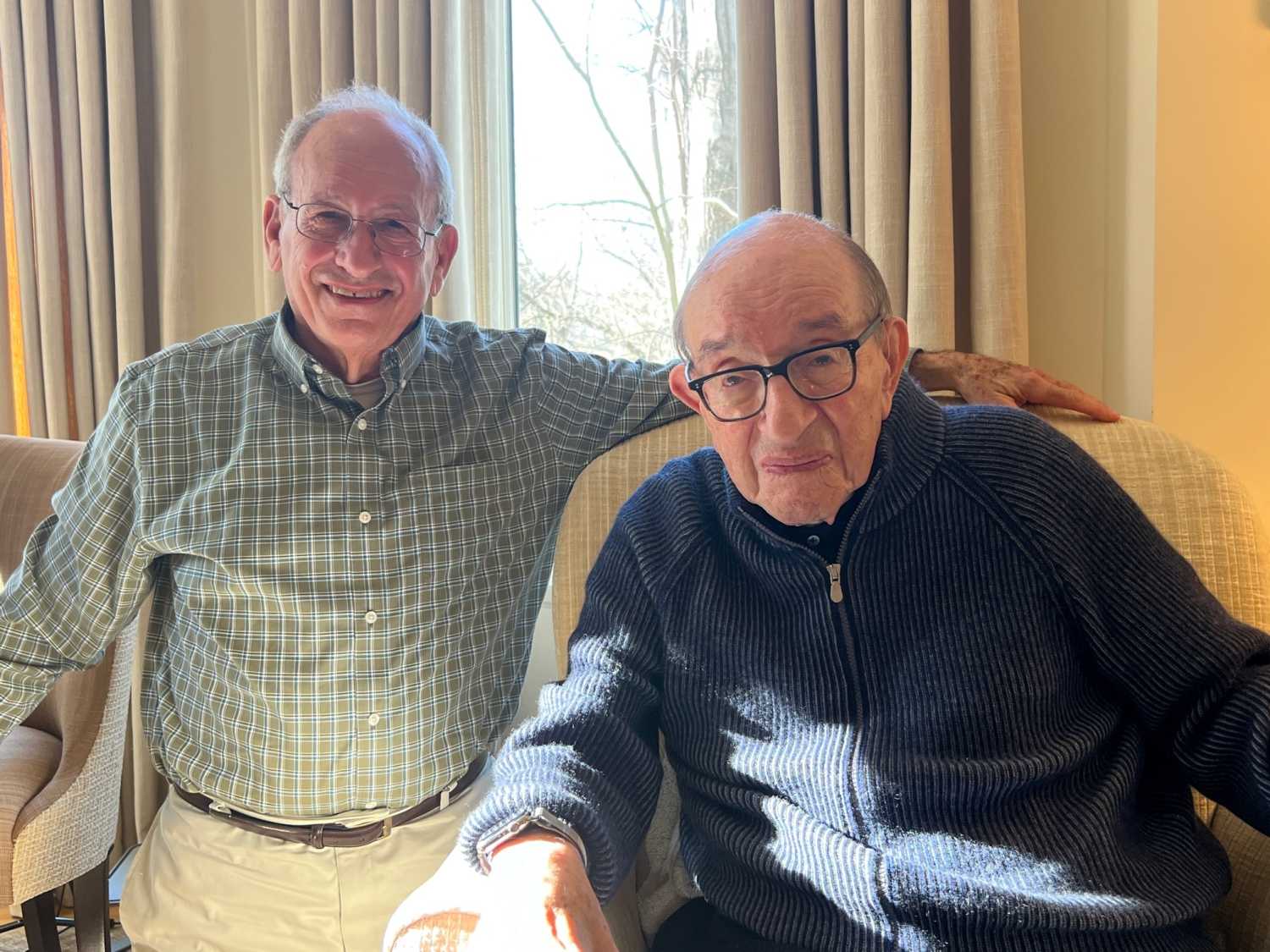
We were reminiscing during a recent visit at his home, and Alan summed it up with “We had fun, didn’t we, Don.” Yes, Alan, we had fun—maybe as only a couple of policy nerds would define that word. And his “fun” enriched policymaking and economic analysis in the U.S. and around the world. Thank you, Alan.
Author
The Brookings Institution is committed to quality, independence, and impact.
We are supported by a diverse array of funders. In line with our values and policies, each Brookings publication represents the sole views of its author(s).


Comments
Post a Comment