Jürgen Habermas
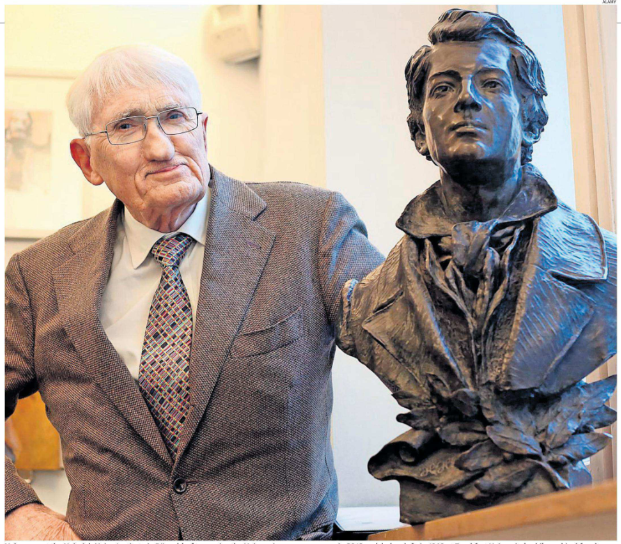
In 1953 a young German journalist caused a furore by attacking the country’s greatest living philosopher, Martin Heidegger, in an article in the Frankfurter Allgemeine Zeitung. Heidegger had just published some lectures from the 1930s, complete with his unaltered comments about the “inner truth and greatness” of the National Socialist movement. What was so shocking, the article declared, was not so much Heidegger’s support for the Nazi regime at the time, but his inability to utter a single word of remorse for all the horrors it had committed.
The young man who broke ranks by daring to express his “incredulous outrage” in this way was Jürgen Habermas.
His outspokenness, his commitment to the democratic Germany that had risen from the ashes and his resolve not to let his fellow citizens forget the past were to become permanent features of his life and thought.
Habermas was the foremost philosopher and social theorist of postwar Germany.
A towering presence in the intellectual and political life of his native country for more than 60 years, he was also renowned around the globe. His many books have been translated into more than 40 languages. His enterprise was unique: nothing less than a comprehensive theory of modern society and its underlying dynamics, covering every sphere from politics and law, to science, culture and religion.
As the doyen of the second generation of the Frankfurt School of social theory, his aim was a critical assessment of the achievements and the failures of the modern world. There have been few recent thinkers who could match the scope of his endeavour, or the depth of the moral passion that drove it.
Habermas was born in Düsseldorf in 1929, and grew up in the small town of Gummersbach, about 30 miles east of Cologne. His father, Dr Ernst Habermas, was the director of the chamber of commerce and industry there. His family had not been actively pro-Nazi before 1933, but like most middle-class households, accommodated themselves to the Hitler regime.
Habermas was born with a cleft palate, and needed several operations as a young boy, which left him with a permanent nasal intonation. He reflected later in life that the teasing he suffered because of his voice may have helped him to understand experiences of exclusion, while the early surgery instilled in him a deep sense of human interdependence.
At the age of ten he joined the Deutsches Jungvolk, and four years later the Hitler Youth, in accordance with the law, though probably also his family’s wishes.
Habermas trained as a medical firstaider, and in August 1944 he was sent to the Siegfried Line, in a non-combatant support role. His call-up letter for the Wehrmacht came in February 1945, but luckily he was not at home the night the military police came knocking at the door. Within a few weeks, the Americans had arrived.
After the war, Habermas completed his secondary education at the grammar school in Gummersbach. From 1949 to 1954 he studied philosophy, history, psychology, literature and economics, at the universities of Göttingen, Zurich and Bonn. Early during his time in Bonn he met Ute Wesselhoeft, a fellow student, and the couple married in 1955. It was the beginning of lifelong partnership which ended only with Ute’s death last year. He also forged a lifelong friendship with the philosopher Karl-Otto Apel, who was then a teaching assistant several years his senior, and completed a PhD dissertation on the idealist philosopher Friedrich Wilhelm Joseph Schelling. Habermas earned his living in the early 1950s as a freelance journalist, writing book, film and theatre reviews — he was passionate about contemporary theatre — and articles on social problems.
In 1956 Habermas was invited by Theodor Adorno, who had been impressed by some of his journalism, to become his assistant at the Institute for Social Research in Frankfurt. Adorno was a leading figure of the first generation of the Frankfurt School, the group of radical social theorists and philosophers who had first come together around the privately funded institute in the 1930s.
Along with his friend Max Horkheimer, the institute’s director, Adorno had been forced into exile in the USA during the Nazi era. But both returned to Frankfurt after the war to revive the tradition of “critical theory”, as Horkheimer had named it. At the Frankfurt Institute Habermas worked on a sociological inquiry into the political attitudes of students, as well as publishing articles on philosophical and social questions. In the early Sixties he took sides with Adorno against Sir Karl Popper and his adherents in the famous “Positivist Dispute” over the methods of social science. But it soon became clear that his basic theoretical and political intuitions diverged considerably from those of his mentor.
After Germany’s defeat in 1945, Habermas recalled a personal feeling of liberation
In 1958 Habermas left Frankfurt for Marburg, largely because of political and personal tensions with Horkheimer, who regarded him as a left-wing firebrand.
In Marburg he worked with the lawyer and political scientist Wolfgang Abendroth, at the time one of the few openly Marxist academics in West Germany.
In 1962 he completed his habilitation, or second doctorate. This was on the rise and decline of the “public sphere” of political discussion and debate, which, so he argued, first emerged in the salons and coffee houses of 18thcentury Europe. The notion that a vibrant public sphere is a crucial element of democracy was to become one of Habermas’s basic convictions. His historical and political argument to this effect, published in 1962 as The Structural Transformation of the Public Sphere, received wide acclaim.
Also in 1962, Habermas was appointed to a post as extraordinary professor of philosophy at the University of Heidelberg, on the initiative of Karl Löwith and Hans-Georg Gadamer. But two years later he returned to Frankfurt University to succeed Horkheimer as professor of philosophy and sociology.
It was a meteoric rise. Now regarded as the inheritor of the mantle of the Frankfurt School, Habermas published a series of books that established his international reputation. These included Theory and Practice (1963), Technology and Science as Ideology (1968), and Knowledge and Human Interests (1968).
Habermas always recalled the defeat of Germany in May 1945, his personal feeling of liberation in glorious spring weather and the subsequent revelations of the criminality of the Nazi regime as the crucial episode in his moral and political development. He was deeply appreciative of the Allies for having brought liberal-democratic norms to Germany. Referring to the prosperous, consumerist Federal Republic of the 1980s, he once admitted to being “ambivalent because I have the impression that something is deeply amiss in the rational society in which I grew up and in which I now live. On the other hand, I have also retained something else from the experience of 1945 and after, namely that things got better.”
Habermas’s strong commitment to parliamentary democracy set him off from his predecessors in the first generation of the Frankfurt School, who focused on the worst features of advanced capitalist societies: the increasing commodification of all aspects of life, bureaucratic intrusion, and the manipulation of consciousness, through advertising and the debased mass media. While Habermas remained alive to these phenomena, indeed sought to theorise them, he also insisted they were only one side of the story of modernity. The other side was the unleashing of what he called “communicative reason”: the idea that the path to just solutions can only pass through free and open discussion by all those concerned.
This ambivalence that helps to explain Habermas’s tense relations with the student movement of the late 1960s.
He sympathised with the students’ critique of modern technocratic capitalism, and saw the wave of protest as a possible catalyst for a revived “public sphere”. But his deep anxiety that liberal and democratic values still only had shallow roots in German society led him to oppose strongly the use of “extra-legal means” by the students, and especially the use of violence.
He was always ready to leap into the fray when he felt some important principle was at stake. In 1967 he made an impromptu speech at a meeting in Hanover, attacking some of the leaders of the revolt, including Rudi Dutschke, for “left-wing fascism”. It was a remark that caused deep resentment among the young radicals, and a breach that was never fully mended, despite Habermas’s subsequent retractions.
In 1971 Habermas left Frankfurt for the Bavarian town of Starnberg, where he became director of the Max Planck Institute for research into conditions of life in the scientific and technological world. There he aimed to lead an interdisciplinary research programme on modern society, very much in the spirit of the early Frankfurt School.
Although he returned to the philosophy department at Frankfurt in 1982, and taught there until his retirement in 1994, his main home remained in Bavaria. Starnberg is a prosperous suburban town, set on a lake south of Munich. The snow-capped Bavarian Alps rise beyond the water in the distance.
There Habermas and his wife lived in an austerely modernist villa, hung with examples of the abstract painting that so excited him when the floodgates of culture were opened again in Germany after the Second World War.
After retiring, Habermas continued to write prolifically, on philosophy, politics and current affairs, in his study at the back of the house overlooking a grove of pines. During these years he also travelled widely on lecture tours, in Israel, the Far East, north Africa, South America and elsewhere, and took up various temporary teaching appointments, mainly at universities in the United States.
Habermas’s knowledge of the history of philosophy, and of the human and social sciences, was encyclopaedic.
Early on he began to draw on developments in Anglo-American philosophy, especially in working out his own theory of language and communication.
He played a key role in introducing the “analytical” style to a German philosophical world often given over to a rather stodgy, historical approach.
His project was a grand theory of the evolution of human society, and an overview of the development of our moral sense, leading to a critical assessment of the contemporary world. The figures with whom he can justly be compared are the great idealist philosophers of the early 19th century, such as Schelling and Hegel, or the founding fathers of German sociology at the start of the 20th, such as Max Weber and Georg Simmel.
But no less impressive than Habermas’s erudition and his apparently boundless interest in philosophy, politics, society and culture, was his ability to synthesise diverse academic disciplines.
He believed that, after Hegel and Marx, philosophy could no longer go it alone. Philosophical reflection had to be integrated with empirical social science, to produce a comprehensive account of our complex modern condition.
Habermas’s major contribution to social theory, the two-volume Theory of Communicative Action, was published in 1981. Here he seeks to understand the nature of modern society by drawing a basic distinction between “instrumental” or “functionalist” reason, on the one hand, and “communicative reason” on the other.
Instrumental reason enables us to find the most efficient means of achieving a given goal. But this kind of calculation cannot guide us in deciding what goals, either moral or political, we ought to pursue. Communicative reason, by contrast, describes all the abilities we employ when we discuss with others, with the aim of reaching agreement on common purposes. Habermas’s basic philosophical insight is that genuine agreement cannot be compelled. It can only be achieved when what he famously called the “non-coercive force of the better argument” prevails. This commitment to reason brought him into conflict with French contemporaries such as Michel Foucault and Jacques Derrida, whom he accused of flirting with irrationalism, though he later sought to build bridges with them.
In modern capitalist societies, Habermas argued, ever more areas of life that should be based on co-operation are hollowed out by calculations of profit-making and bureaucratic power.
This is the process that he termed the “colonisation of the lifeworld” — his counterpart to Marx’s theory of alienation.
But against Marx, Habermas held that the complexity of modern society made notions of “direct democracy” unrealistic. He hoped that a vigorous parliamentary democracy, reinforced by pressure from “civil society”, could hold runaway economic and bureaucratic forces in check. In his later major treatise on legal theory (Between Facts and Norms, 1992), he argued that law was a crucial implement for this “democratic self-regulation” of society.
During the 1980s Habermas welcomed the students and younger academics who came from around the globe to study with him.
After his Monday evening colloquium at the University of Frankfurt, the custom was to move on to the local Greek taverna, where the discussions and conviviality would continue till late, over food and beer. He had an endless curiosity and zest for debate, and an eagerness to understand the younger generation. After a guest lecture, he would sometimes spend the evening in a corner of the pub, entertaining students with tales of his encounters with mighty figures such as Hannah Arendt and Herbert Marcuse, as well as patiently answering their philosophical questions.
In his later years, Habermas’s attention turned largely towards the philosophy of religion. In 2019, at the age of 90, he published a massive two-volume work, patiently tracing the intertwining of philosophy and religious thought throughout European, and indeed world history. Although himself “religiously unmusical”, as he put it, he found himself driven to search for the origins of our sense of universal human dignity, and for the archaic sources of social solidarity. He wanted to understand how religions such as Christianity and Buddhism, with their vastly different metaphysical conceptions, could converge on the same basic ethical insights.
He recalled that once, on a trip to Korea, he had spent hours engrossed in conversation with a distinguished Buddhist monk, barely noticing that they were talking through an interpreter. One might fairly summarise his life’s work as an effort to translate religious insights into the unique dignity and irreplaceability of each human person, and the basic need for human solidarity, into terms that could make sense to the inhabitants of a disenchanted, post-Enlightenment world.
His fraught relationship with Britain stemmed from being patronised as a sociologist at Oxford
Throughout his life Habermas not only made outstanding contributions to philosophy and social theory — he also intervened tirelessly, as a speech-giver, journalist and commentator, in the moral and political controversies of his native land. Like Marx, he had a talent for pungent polemic. An emblematic photo from the 1950s shows him addressing a crowd in one of the main squares in Frankfurt, during the protests against Adenauer’s willingness to allow the German armed forces nuclear weapons, under the umbrella of Nato.
His Kleine Politische Schriften — Shorter Political Writings — amount to some 12 volumes, the last published in 2013. What links many of these texts is Habermas’s anxiety about the fragility of liberal-democratic norms in Germany, and a concern that the horrors of the Nazi past should not be repressed by his compatriots, in their eagerness to become a “normal” nation. In the 1960s his rejection of violent protest led him into conflict with the student movement, but more frequently he found himself clashing with spokespersons of the right. In the early 1970s, for example, he criticised the heavy-handedness of the German government’s response to the terrorism of the Baader-Meinhof Group.
In the mid-1980s he launched the “Historians’ Dispute”, denouncing conservative historians who sought to relativise the horrors of the Nazi death camps, portraying them as a perverse response to Soviet Stalinism. Later he criticised the “top-down” process of German reunification, which he feared would lead to a resurgence of nationalism.
And at the turn of the 21st century he leapt into the debate over gene technology, arguing that there must be ethical limits to the engineering of human beings. Gene manipulation would transform a relation between free and equal persons, the basis of our moral life, into a relation between “designer and product”.
Habermas’s fear of nationalism in all its forms made him a passionate advocate of the European Union. He was convinced that the era of nation-state was over, and that new forms of supranational organisation must be developed to control a globalised capitalist economy. The European Union seemed a promising step in that direction, but when the financial crash of 2008 and the ensuing debt crisis brought major conflicts within the eurozone, Habermas felt obliged to intervene ever more frequently and urgently.
The EU needed to democratise its structures, in the hope of creating a pan-European “public sphere”, or it would fail. And Germans, in particular, mindful of the catastrophes of the first half of the 20th century, needed to abandon a narrow view of their national interest, and “avoid the dilemma of a semi-hegemonic status” within the bloc.
Habermas was the winner of seemingly endless academic prizes and awards, and held honorary doctorates from universities around the world. But despite his immense distinction, there was little of the haughtiness of the old-style German professor about him.
He never condescended to more junior colleagues, and would always take their contributions seriously. He was also touchingly appreciative of intellectual support.
Habermas’s wife died last year. They had three children. Rebekka predeceased him in 2023; Tilman and Judith survive him.
In private his manner was kindly and considerate; there was an old-fashioned courteousness about him. He was, though, given to outbursts of vehemence in discussion, especially when he felt some important principle was under threat. He spoke fluent and idiomatic, although accented, English, and enjoyed many aspects of the United States. He was particularly fascinated by New York, which he first got to know when teaching there in the 1960s, at the New School for Social Research on Fifth Avenue, and he felt a strong philosophical affinity with the American tradition of pragmatism.
His relation to Britain was more fraught. After an early experience of being patronised as a mere “sociologist” by philosophers at Oxford, he appeared wary of crossing the Channel. He made more congenial contacts later in life, but, an anti-elitist at heart, it was clear that the class-coded hierarchies and arcane rituals of Oxbridge academic life always made him feel ill at ease. He much preferred the frankness and easy-going hospitality of American colleagues.
Yet despite offers of prestigious posts across the Atlantic, he chose to remain in Germany throughout his career — always fighting to defend the most progressive and enlightened traditions of his native land.
Professor Jürgen Habermas, philosopher and social theorist, was born on June 18, 1929. He died on March 14, 2026, aged 96


Comments
Post a Comment