Putin will never stop trying to export chaos
Just over a week ago, the Chinese aircraft carrier Liaoning entered waters near Japan’s Okinawa islands. In an aggressive act, aircraft launched from its deck locked their radars on to Japanese fighter aircraft that were scrambled in response. Other Chinese aircraft that flew through the area were apparently joined by two Russian Tu-95 bombers. There is no doubt what they were doing: Beijing was demonstrating to the new Japanese prime minister, Sanae Takaichi, that her support for Taiwan comes at a cost.
China was also testing the US reaction to this intimidation of its ally. The US State Department duly put out a statement reaffirming its “unwavering commitment to Japan”, although President Trump has not weighed in himself. In the same week, the new US national security strategy was published, setting out a continued drive in Washington on strengthening military forces and alliances in the Pacific. There will be a “robust focus on deterrence to prevent war in the Indo-Pacific” and a priority of “deterring a conflict over Taiwan, ideally by preserving military overmatch”. Given the rapidly growing strength and assertiveness of Chinese forces, such “overmatch” will require much greater and more capable US deployments in the Pacific.
It is against this background that Trump and his informal negotiating team, Steve Witkoff and Jared Kushner, are this week pressing President Zelensky to agree terms for ending the war in Ukraine that might be acceptable to President Putin. At first glance, you can see the logic: China is the real competitor to the US, America can’t do everything, the Europeans have been freeloading on US help for a long time, so shut this problem down with any deal that works and concentrate on China. That is why the same US document calls for “strategic stability” with Russia and declares that it is “a core interest of the US to negotiate an expeditious cessation of hostilities in Ukraine”.
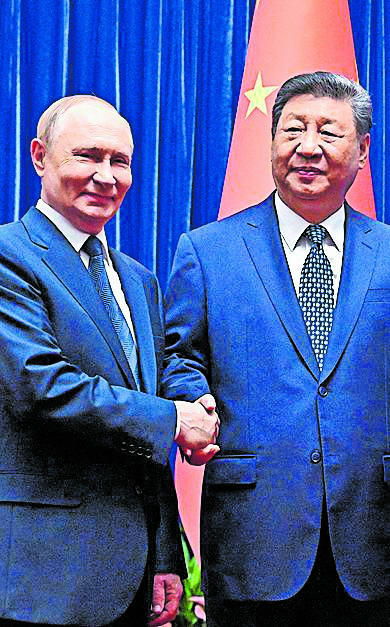
Behind those words is another, grander, ambition: to separate Russia from China, to pull the bear from the embrace of the dragon. This is the idea of the “reverse Nixon”, to repeat the boldest strategic move of the Cold War — Nixon’s establishment of diplomatic relations with Mao’s China in 1972 to isolate the Soviet Union. The secretary of state, Marco Rubio, said earlier this year that America can’t let Russia become China’s junior partner. Trump himself has mused that “I’m going to ununite them [Russia and China] and I think I can do that.”
US negotiators aim to perform a magnificent act of geostrategy
This is the thought that lies behind all the frantic meetings we will see this week — the rushing to Berlin, the pressure on Zelensky to settle, the fight in the EU to use the frozen Russian assets before it’s too late.
The US negotiators are aiming not just to secure the Nobel peace prize for Trump but to perform a magnificent act of geostrategy that will be written about for centuries.
The hope for such a grand, strategic move is linked to an understandable exasperation with Europe’s economic decline and a predictable thirst for business deals with Moscow but it is nevertheless a big, bold, thought. It is a clear plan. It is a genuine attempt to implement a global strategy. Unfortunately, it is a very big mistake. And for multiple reasons.
It is a mistake because strategic stability with Russia cannot be secured by concessions; because Russia has grown too dependent on China to be separated from it; and because a successful global strategy will require more consistency across different theatres of conflict around the world. The new US national security strategy takes no account of those factors and could therefore lead to great error.
We tried for many years to find “strategic stability” with Russia — I was part of that as foreign secretary until Putin invaded Crimea. It proved impossible because what threatens Putin is not the actions of democratic neighbours but their existence.
People in Estonia or Poland are living proof of the benefits that freedom can bring, and it was too much for him that people in Georgia, Ukraine or Moldova might become evidence of that too. It is an illusion to think you can just cut a deal with him and all will be well.
The new head of MI6 is warning that Putin will continue to “export chaos” until he “is forced to change his calculus”. She is spot on. Putin is close to demonstrating that he can seize territory by force, outlast the staying power of the West, sow mayhem in democracies and divide Europe from America. Having discovered that this works, he will go on doing so unless faced with exactly the kind of “military overmatch” the US is advocating against China in the Pacific. This is why, as Zelensky insists, peace will only be sustainable with credible guarantees from the western alliance, including the US, to defend Ukraine from further attack.
The laudable notion of separating Russia from China is wishful thinking. Putin does not trust democracies, in which leadership changes unpredictably. His war effort is only viable because of Chinese help, providing crucial supplies of engines for drones, fibre optic cables and lithium-ion batteries. New gas pipelines are making Russia dependent on China’s demand for energy, while co-operation in finance, space and military exercises is closer than ever. Putin will cut deals with the US but he will never turn away from China in a crisis. With shared interests around the globe, such as in North Korea and Iran, the autocrats will stand reliably together.
In geopolitics, the continents are thus connected to each other far more closely than the US strategy accepts. Seen from Washington, it seems that each theatre is now to be treated differently. In the Americas, the Monroe Doctrine of US preeminence is being strengthened with a “Trump Corollary” and an expansion of power. In Europe, Russia needs sufficient buffer zones to be satisfied, while in the Pacific, China needs to be contained with strong alliances and increased military strength. Yet if both the US and Russia can use hard power to expand their regional sphere of influence, why won’t China want the same?
Russia’s war effort is only viable because of Chinese help
There is thus a major flaw in the new US national security strategy. Treating an expeditious peace in Ukraine as a core US interest, to the point of forcing an unsatisfactory deal on Europe and Ukraine, is inconsistent with building alliances and deterrence in the Pacific. Russia will stay close to China whatever happens, and China will draw the lesson that western alliances can be undermined and faced down, including over Taiwan. A world in which Putin can credibly claim success and vindication over Ukraine is also a world in which Chinese aircraft carriers will ever more confidently test, to breaking point, the resolve of the United States.


Comments
Post a Comment