- Get link
- X
- Other Apps
Is ‘ The West’ Over?
As U. S. relations with Europe sour, longtime allies wonder if the world order will ever be the same.
BY DAVID LUHNOW AND MARCUS WALKER
THE WESTERN ALLIANCE between the U.S. and its European partners has been a pillar of the global order since the end of World War II. Bonded by a common belief in freedom and democracy, it prevented major global conflict, defeated Communism and presided over a surge in global prosperity.
Now, European leaders are asking whether it’s dead.
“What we once called the normative West no longer exists,” German Chancellor Friedrich Merz, the leader of Europe’s most populous democracy, recently said at a gathering of business leaders in Berlin. Days later, the conservative and lifelong Atlanticist wistfully called on Germans to put aside nostalgia for an America they had known and loved for decades. “The Americans are now pursuing their own interests very, very aggressively” he said, and Germany must do the same.
A winter chill has settled on the transatlantic relationship, and
many fear it might never recover— at least not fully. Merz and his European counterparts say they are waking up to a sobering realization: The U.S., at least under the current administration, no longer views Europe as its crucial partner in world affairs. The White House is increasingly hostile to the continent and regularly uses harsher language to describe European democracies than it does for traditional adversaries like Russia or China.
Part of what’s driving this shift
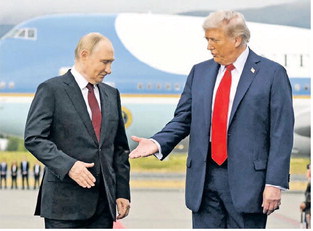
“There seems to be this strange meeting of minds between the Americans and Russians over what Europe should look like,” historian Sergey Radchenko said. ANDREW CABALLERO- REYNOLDS/ AFP/ GETTY IMAGES
is a fundamental disagreement over what the West stands for, and which side of the Atlantic is doing a better job defending its core values. Many in the Trump administration feel that Europe is betraying Western civilization by allowing immigration to dilute its historic roots as a largely white and Christian region. They also say European elites are driving a diversity agenda in part by restricting free speech and political freedoms.
European leaders disagree, and point out that they regularly get stronger scores on democracy rankings nowadays than the U.S. They argue that underlying values should matter more than race or religion. They also worry that Washington is the one abandoning western values by cozying up to land-grabbing autocrats and making territorial claims on allies such as Canada and Denmark.
It isn’t simply the Trump administration’s words that have shocked Europe’s political mainstream; it’s that the rhetoric is backed up by action. Washington is energetically seeking a geopolitical accommodation with Moscow, partly in pursuit of lucrative business deals. President Trump’s envoys are pressuring Ukraine to agree to a string of territorial and other concessions that most European capitals fear could destabilize the region by emboldening Russia rather than punishing it for invading a sovereign neighbor.
“For the U.S. to drop its alliance with Europe and side with Russia, with Putin the aggressor, just as Russia threatens us with war: That represents a fundamental break in the European-US relationship,” says Norbert Röttgen, a center-right German lawmaker and former head of the foreign affairs committee in the German Parliament. French centrist politician Claude Malhuret told the French Senate: “Today, at best, Europe is alone. At worst, it faces two enemies: Russia and Trumpism.”
The broadsides against Europe began in February when Vice President JD Vance delivered a blistering attack on traditional allies followed months later by tariffs on many European goods. But the past several weeks have turbocharged the sense of rupture. First came the 28point peace plan for Ukraine crafted by American and Russian negotiators and seen in most European capitals as heavily tilted in Moscow’s favor.
Then in early December came the most recent edition of the U.S. National Security Strategy (NSS), a document periodically issued by the president setting out guidelines for American foreign policy. This one read to many Europeans as if the U.S. were filing for divorce, lambasting the continent for democratic shortcomings and accusing its elected leaders of doubling down on immigration policies that could turn their populations into “majority non-European.” The unspoken implication of this “civilizational erasure” was that immigrants and their descendants can’t become European and adopt western values. The document wondered aloud whether such countries could remain “reliable allies.”
The NSS codified Vance’s rhetoric as official U.S. policy, declaring the European Union an enemy of national sovereignty and vowing to intervene in Europe’s internal politics by promoting antiimmigration parties, many of which are more hostile to the EU than to Russia. “It read like a declaration of political war on the European Union,” said Timothy Garton Ash, a British historian.
The Western alliance still has plenty of defenders in the U.S. A different president could bring another shift in tone, even if U.S. and European political priorities never again converge as closely as in the postwar decades. Many Europeans and Americans still share deep affinities— from popular culture to fundamental political values—and recognize each other as bastions of democracy in a world where autocracies are once again rising.
But something now feels broken. “We’ll never have that confidence again that the United States is on our side,” said Garton Ash.
The West as an idea
The definition of “the West” has been contested, debated and revised over time, said Georgios Varouxakis, author of the book “The West: The History of an Idea.” Given generations of social change in both the U.S. and Europe, he said, one thing is clear: “It’s too late to say you have to be white and Christian to be Western.”
The book traces how the concept of the West was spread by nineteenth- century French thinkers such as August Comte, who espoused a society based on reason and saw Europe in contrast to the rising autocracy to the East, Russia. By the twentieth century, the idea of Western civilization had taken hold in the U.S., which had earlier sought to distinguish itself from the Old World. This shift helped bolster the case for U.S. intervention in Europe in both world wars.
During the Cold War, the West became synonymous with the non-Communist “free world,” and eventually with development and modernization. Nations anywhere could “Westernize” their way of life by embracing democratic constitutions, individualism and consumerism. Immigrants and minorities in the U.S. and Europe who embraced Western values could apply them to challenge unequal treatment.
Many Europeans argue that the Trump administration is projecting America’s internal culture wars onto European societies, based on conservative anxieties about fast-changing demographics and ethnic diversification. “America was the New World, running away from the closed, culturally homogenous societies of the Old World. Now it feels betrayed by the fact that the Old World is becoming more
like America,” said Ivan Krastev, a Bulgarian political thinker.
But many Europeans also agree with some of Washington’s criticisms of the continent, especially when it comes to sluggish economic growth, excessive regulation, reliance on the U.S. for security and a lack of immigration control that’s fueling a voter backlash.
“Europeans need to take much bolder steps on everything from innovation to economic policy. If we remain dependent on the U.S. in terms of technology, markets and security, we will become a vassal and constantly humiliated,” says Jérémie Gallon, a former French diplomat.
Behind the transatlantic tensions of 2025 lie two major shifts in how the U.S. views the world. One is Europe’s declining economic, military and demographic weight compared with Asia. Starting with Barack Obama, recent U.S. presidents have talked about pivoting attention away from Europe to focus on China.
The other is the Trump administration’s disdain for multilateral institutions, whose rules it considers impediments to the pursuit of American interests, even though the U.S. played a lead role in establishing the U.N., the WTO and other organizations upholding transnational agreements. Nor does Washington continue to proclaim the goal of spreading democracy and freeing the oppressed— except in Western Europe. “This feels like the transatlantic relationship as a values-based relationship is on its deathbed,” said Laurel Rapp, Chatham House program director for North America, and a former deputy director of the State Department who helped put together the previous NSS under the Biden administration. It made U.S. relationships with European democracies the anchor of its global approach. Europe must now negotiate a whole new bargain with the U.S., Rapp said. “It can’t be a valuesbased alliance on democracy and human rights. The direction of travel is commerce, deals, deregulation. In other words: What does the U.S. get very materially from Europe?”
A trusted ally?
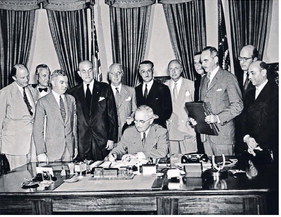
The past year has sowed doubt in many Europeans’ minds about the strength of U.S. commitment to the North Atlantic Treaty Organization, the bedrock of European security for 75 years. If Russia imposes its will on Ukraine, rearms, and makes an incursion into Estonia or Lithuania in a few years’ time, will the U.S. go to war for a small European ally and uphold Article 5 of NATO’s mutual defense treaty?
At a recent dinner with a former American diplomat, a senior British naval officer said he no longer believed the answer is an unqualified yes, and that, for the first time in his career, he no longer trusts the U.S.
Andrew Roberts, a conservative British historian, said alienating allies poses longer-term risks for the U.S. An advantage America has long enjoyed over Russia and China has been its web of allies who trust it to do the right thing, including standing up to dictators, he said.
“This new transactional approach sees the cost of everything and the value of nothing,” he said. “They see national greatness entirely through the lens of dollars, and not the lens through which America has long been viewed—as a beacon of hope.”
American hostility to the EU and support for populist parties is gratifying to Moscow. Since World War II, Russia has wanted to get the U.S. out of Europe and then fragment Europe politically so it can project power without facing a unified adversary, says Sergey Radchenko, a Russian-born historian at Johns Hopkins University.
“There seems to be this strange meeting of minds between the Americans and Russians over what Europe should look like,” he said. “You have the U.S. and Russia effectively working hand in hand to undermine the project of European unity, a project the U.S. helped create.”
Roberts, the British historian, says the U.S. and Europe should weigh the costs of breaking up the West. “I understand America is tired of the role of global policeman,” he said. “But I’m sure China will be more than happy to become the world’s secret policeman.”
“Today, at best, Europe is alone. At worst, it faces two enemies: Russia and Trumpism.”
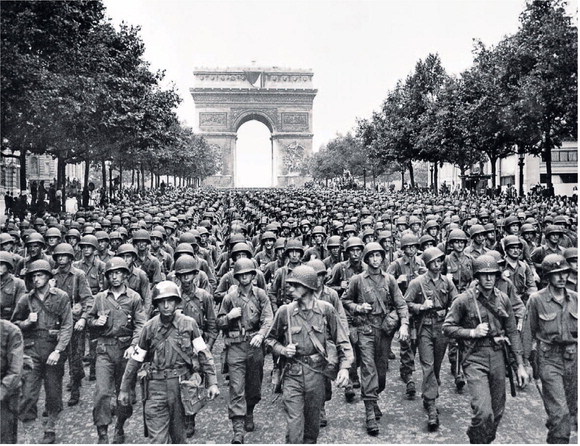
FROM TOP: BETTMANN ARCHIVE/ GETTY IMAGES; CORBIS/ GETTY IMAGES; CHRISTIAN HARTMANN/ PRESS POOL/ AFP/ GETTY IMAGES From the liberation of Paris (above) to the creation of NATO (right), Europeans and Americans once forged deep bonds from shared values.
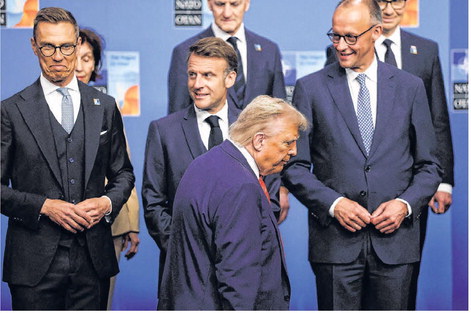
The NATO leaders summit in June, 2025. The most recent National Security Strategy outlining U.S. foreign-policy guidelines read to many Europeans as if the U.S. were filing for divorce. It berated the continent for its shortcomings.
- Get link
- X
- Other Apps


Comments
Post a Comment