- Get link
- X
- Other Apps
China Turns Into Test Lab for West
Competition pushes some brands to use the Asian country as an innovation hub
BY HANNAH MIAO
SHANGHAI—For Western companies in China, a new reality has set in: The easy money is gone and competition is only getting fiercer.
As China’s economic growth has slowed in recent years, consumers have become choosier about their spending. Meanwhile, the rise of formidable local rivals has crowded the market and driven vicious price wars, eating into profit margins.
International brands are getting more realistic. Their strategies vary by company and industry but include tailoring products to Chinese tastes, developing them at a faster pace, marketing them differently and lowering prices.
Many companies can’t afford to ignore the country of 1.4 billion people, the world’s second-largest consumer market. And even if sales in China remain lackluster, some are eyeing the country as a critical innovation hub to learn from.
Olivia Plotnick, founder of marketing agency Wai Social in Shanghai, said she used to hear from American companies interested in launching in China. Since the pandemic, she estimates inquiries have dropped by about three-quarters. Instead, her clients these days are mostly foreign brands that have been in China for some time but now realize they need to revamp their strategies.
“It is becoming a lot trickier for foreign brands,” she said.
For years, as China’s economy expanded rapidly and millions joined the middle and upper classes, the country was a cash cow for companies such as Louis Vuitton parent LVMH , Starbucks , Nike, Apple and Tesla,
which faced little competition from Chinese brands.
Now, homegrown rivals have overtaken Western brands in China in many industries. Starbucks recently announced it was selling a majority stake in its China business to Chinese privateequity firm Boyu Capital. The American coffee company has lost market share in China to cheaper, local rivals such as Luckin Coffee, which dethroned Starbucks as the country’s biggest coffee chain by sales and stores in 2023.
In a recent survey by the American Chamber of Commerce in Shanghai, 63% of respondents cited domestic competition as a top challenge. Local competitors tend to be speedier to market, respondents noted.
Making money in China has become harder as economic momentum has weakened. In the aftermath of a propertymarket collapse that began around 2020, consumer confidence has taken a hit, with households guarding their savings and watching their spending. That in turn has prompted many companies to turn to price cuts to entice shoppers.
Another challenge: Heightened U.S.-China tensions are leading some corporate head-
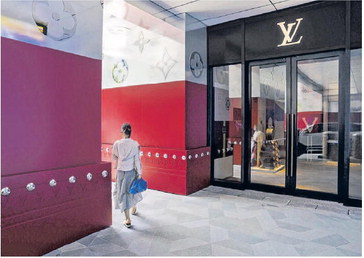
Western companies are tailoring products to Chinese tastes. A Shanghai Louis Vuitton store. RAUL ARIANO/ BLOOMBERG NEWS
quarters to exercise more caution on China-related decisions, which can slow operations.
“In China, success depends on how fast you can turn the steering wheel. But for many multinationals, the wheel is in the U.S. where the instinct is to hit the brakes, not the gas,” said Han Lin, China country director at consulting firm the Asia Group.
‘Fitness center’
The fierce competition is perhaps most apparent in China’s auto industry, where price wars have broken out and local companies have taken market share from longdominant foreign car brands.
Volkswagen was once the top carmaker in China, but homegrown brand BYD took the crown in 2023. Volkswagen’s vehicle deliveries in China fell 7% in the latest quarter from a year earlier, the latest in a string of weak results in the country.
Volkswagen has likened China to a “fitness center” for the company. The German automaker is doubling down on its “in China, for China” strategy of developing and manufacturing products in the country for Chinese consumers. At a recent import expo in Shanghai, Volkswagen said it is developing its own chip for advanced driver-assistance systems and autonomous driving through a joint venture with a Chinese firm.
It also showcased new, lower-cost models designed for Chinese consumers, which have been developed about 30% faster than previous models, part of an effort to win back market share from local rivals. One is the fully electric Audi E5 Sportback with advanced driver-assistance features, which was developed in two years and starts at around $33,000. That compares with the gas-powered Audi A5L, which starts at around $36,000 in China.
“We are investing heavily in engineering capabilities, and especially here in China, because China is the most innovative hub for driving the automotive industry,” Oliver Blume, chief executive of Volkswagen, said at the import expo.
For many foreign carmakers, operating in China is about being near the action and the supply chains.
“There is a sense of urgency among the foreign auto firms to figure out how they compete with Chinese firms in the global market,” said Guo Shan, a Shanghai-based partner at the advisory firm Hutong Research. “The answer for them right now is that they have to be in China to stay close to the innovation.”
“If you do not compete with them in China, eventually you will still need to compete with them outside China,” she said.
Tweaking playbook
Gabrielle Saint-Genis,
CEO of Guerlain, an LVMH-owned French luxury perfume, cosmetics and skin care company, said after decades of “hyper growth” in China, Guerlain now faces competition from local rivals.
“Times have changed,” she said of the broader Chinese market. “The consumer has been more demanding…The quality has to be worth the price.”
Guerlain next year is launching a lipstick that costs around $56, a more affordably priced luxury product to attract younger customers, she said. The brand currently sells lipstick for as much as $94 on e - commerce platform Tmall. Guerlain is also working with Chinese artists and social-media platforms to promote products in a more localized way.
Swedish furniture retailer IKEA has pledged to lower prices in China on more than 150 bestselling items and invest more than $22 million in the market. It is also planning to launch more than 1,600 new products for Chinese consumers.
“Right now, actually, we are mostly looking at the Chinese market as an innovation testing ground,” said Ivy Zhang, a representative for IKEA China.
Procter & Gamble recently reported “very strong progress” in China after tweaking its strategy to focus on innovative products designed for local consumers.
At the import expo, it showcased a new whitening toothpaste for the Chinese market, developed at Crest’s Beijing research institute.
Amy Alt, president of oral care at P&G China, said the company has focused on enticing packaging, attention-grabbing marketing on Chinese social media and value-formoney products to stand out.
“It’s a competitive market,” said Alt. “But competition makes everyone better.”
Bright spots
Some companies are managing to buck the broader trend. American retailer Ralph Lauren’s China sales grew more than 30% in its latest quarter from a year earlier. Cosmetics maker Estée Lauder’s mainland China revenue increased about 9% year over year in the three months ended September. Domino’s Pizza CEO Russell Weiner said the chain’s business in China is “doing amazing.”
China is the fastest-growing geographic segment for American conglomerate 3M . CEO Bill Brown on an Oct. 21 earnings call said the company recently launched a new product in China in 10 months to better match the pace of the Chinese manufacturers that buy its products.
“We’re seeing a lot more hustle, a lot more speed,” Brown said. —Zhao Yueling contributed to this article.
Homegrown rivals have overtaken some Western brands in China.
- Get link
- X
- Other Apps


Comments
Post a Comment